Last updated November 17, 2026
The Complete Radiant Barrier Installation Guide for Las Vegas Homeowners
Las Vegas attic deck temperatures routinely hit 160°F in July. A radiant barrier doesn’t block that heat. It reflects it back before it can radiate down toward the insulation and ceiling below. But the reflection only works when the foil faces an air gap, and that gap is the one detail most installation guides skip entirely. Get it right and you’ll cut cooling load noticeably. Get it wrong and you’ve paid for shiny paper that does nothing. This guide covers the two installation geometries used in Las Vegas, the required air gap, the fastening schedule, and the before-and-after test that proves whether the product actually earned its keep.
Quick Answer
A radiant barrier installed in a Las Vegas attic reduces heat radiating down from the roof deck by reflecting it back across a maintained air gap. To work, the foil must face an open space of at least 1 inch (2 – 3 inches is better), the seams must be taped, and attic ventilation at the ridge and soffit must stay clear. Installed correctly, studies cited by the U.S. Department of Energy point to a 15 – 25% reduction in cooling load. Installed against insulation, it delivers close to nothing.
Table of Contents
- What a Radiant Barrier Actually Does in a Las Vegas Attic
- The Two Installation Geometries and When Each Applies
- The Air Gap: Minimum, Ideal, and What Destroys the Advantage
- Fastening Schedule, Seaming, and the Perforated vs. Solid Decision
- How We Verify: The Solar-Noon Temperature Test
- Nevada Code Requirements: IRC R806 and What Fails Inspection
- What Radiant Barrier Installation Costs in Las Vegas
- Common Mistakes to Avoid
What a Radiant Barrier Actually Does in a Las Vegas Attic
A radiant barrier is a low-emissivity foil, typically aluminum on one or both sides of a reinforced substrate. In a Las Vegas attic, the roof deck absorbs the full afternoon sun and reaches surface temperatures that will peel paint off a car. That deck then radiates heat downward in the form of infrared energy, and the fiberglass or cellulose on your attic floor absorbs it. The result lands on your ceiling and, eventually, in the rooms below. Your air conditioner fights a ceiling that has been heated from above all day.
The foil interrupts that transfer path. Emissivity is a measure of how readily a surface gives off radiant heat, on a scale from 0 to 1. Bare aluminum foil sits around 0.03 to 0.05, meaning it rejects 95% or more of the radiant energy that hits it. When the roof deck radiates downward and the foil is in the path with an air gap on the reflective side, most of that energy reflects back toward the deck rather than being absorbed.
What a radiant barrier does not do is insulate. It has no meaningful R-value in the way that fiberglass, cellulose, or foam does. It does not stop air leaks, and it does not cool the deck itself. In the Las Vegas climate, that distinction matters because the barrier works hardest from roughly April through October and contributes little during the mild winter. Many homeowners pair it with additional attic insulation, and the two together do more than either alone. If you want to understand the whole envelope picture, our attic insulation in Las Vegas guide covers how R-value stacking works alongside reflective products.
The Two Installation Geometries and When Each Applies
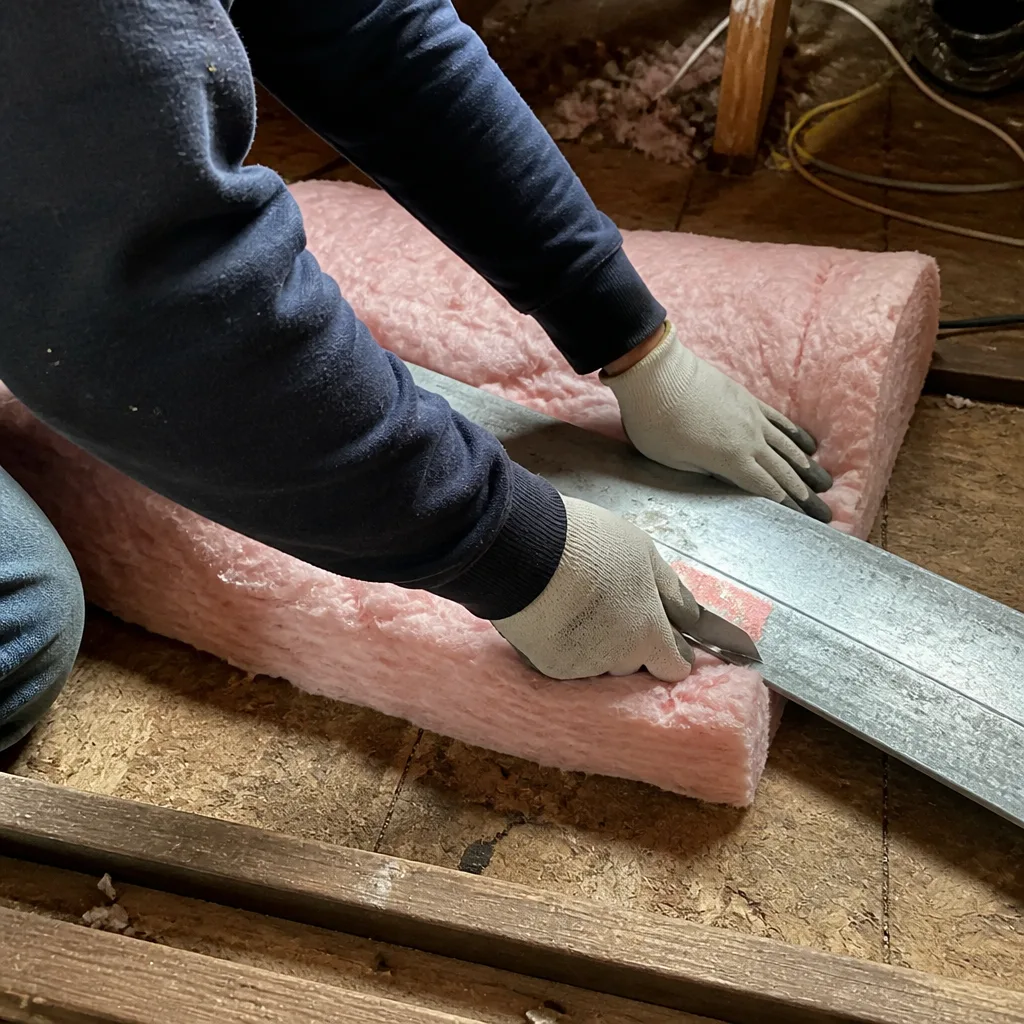
In the Las Vegas market, radiant barrier foil goes in one of two ways. Each has a specific set of conditions, and choosing wrong wastes money.
Rafter-Draped Installation
The foil runs across the sloped underside of the roof rafters, following the pitch of the roof itself. It stays in contact with the rafter faces and is secured to them. This geometry is appropriate when:
- The attic is being set up as a vented, unconditioned space and the foil needs to intercept heat at the deck.
- You have adequate soffit-to-ridge ventilation and the drape will not block the airflow path.
- No existing blown-in insulation is already piled high against the rafters at the heel, which would touch the foil.
Truss-Chord Stapled Installation
Here the foil is stapled horizontally across the top or bottom of the truss chords, parallel to the attic floor. This is more common in production housing across the Las Vegas valley, including the dense subdivisions of Summerlin and North Las Vegas. This geometry only works when the foil is installed on the underside of the top chord, facing down, so the reflective surface looks at the attic floor and the air gap stays between the foil and any insulation below. It is incompatible with existing blown-in insulation that already reaches up to the chord line, because the foil would touch the insulation and lose its advantage.
In our experience, the majority of Las Vegas homes with existing attic insulation already installed are better candidates for rafter-draped foil, or for foil installed on the underside of a raised chord with a maintained gap, not for stapling directly over a full insulation bed.
The Air Gap: Minimum, Ideal, and What Destroys the Advantage
The air gap is where the whole product succeeds or fails. The reflective surface must face an open, still air space to do its job. The minimum is 1 inch. Ideally, you want 2 – 3 inches for reliable performance and to tolerate the seasonal movement of insulation or the occasional install of a new duct run.
Why contact destroys it: if the foil touches fiberglass, cellulose, or a duct, the surface goes from “low emissivity” to “in thermal contact with a material that conducts and absorbs.” The reflective advantage disappears. The foil becomes a thin, expensive sheet that conducts heat straight into your insulation. Studies and manufacturer guidance all say the same thing: no contact allowed on the reflective side.
What eats the gap in Las Vegas:
- Settling blown-in insulation reaching up to the foil when installed too close.
- HVAC duct runs or flexible duct drops pushing against the foil.
- Fasteners or furring strips installed with no gap measurement taken.
- DIY installs where the foil is stapled tight across the truss chord with insulation puffed up beneath it.
A 2-inch gap measured with a tape at the low points of the foil is the simple, defensible standard. If the installer cannot show you that measurement, the job is not ready to close.
Fastening Schedule, Seaming, and the Perforated vs. Solid Decision
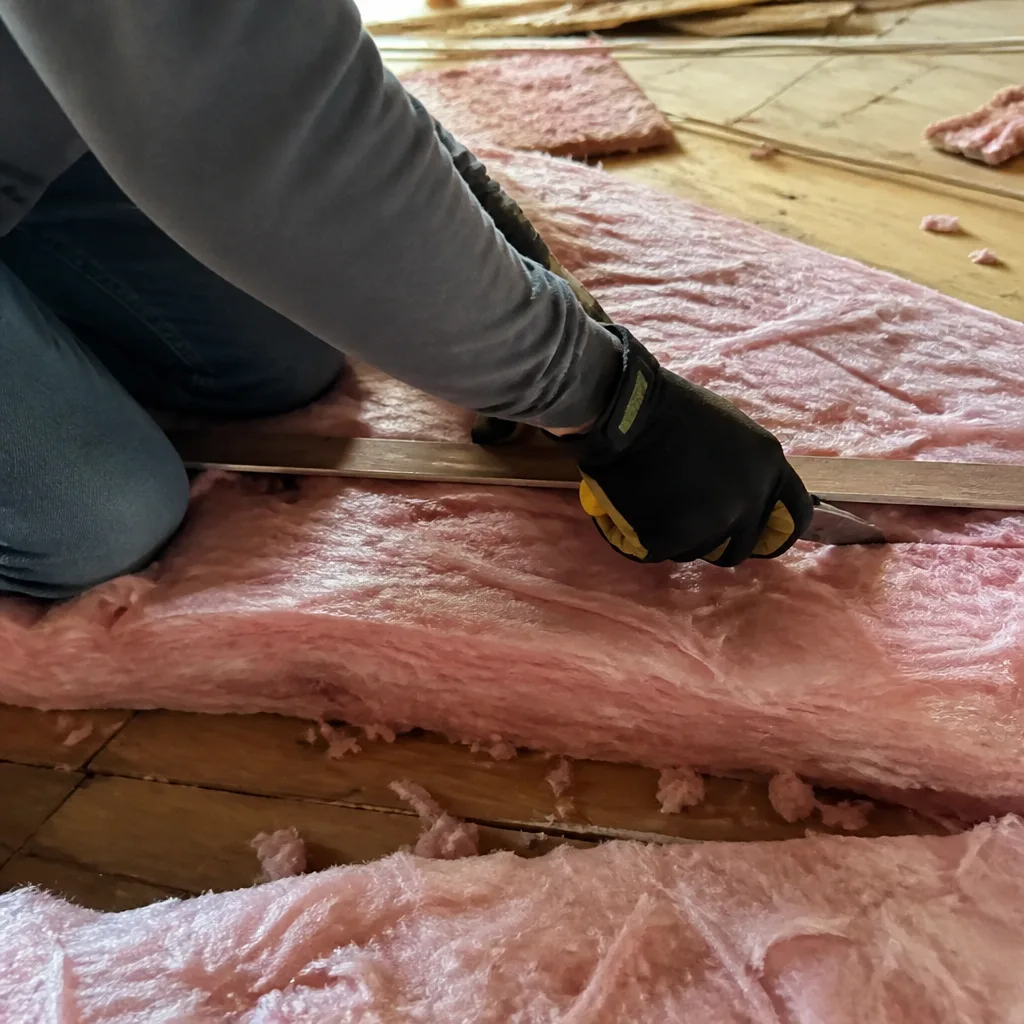
Fastening matters because a loose or torn sheet breaks the reflective plane and opens seams that let attic air move across the foil surface. Here’s the schedule we use on Las Vegas jobs:
- Staples every 8 – 12 inches along each fastening line, using staples wide enough to catch the foil without tearing through it.
- Overlap seams 2 inches minimum, foil face over foil face, so water and air can’t wick between sheets.
- Seam tape rated for radiant barrier use. Foil-to-foil acrylic or butyl tape, applied with a roller, not a hand press. Standard duct tape is not spec.
- Penetrations around vents, conduits, and pipe boots slit and lapped, then taped, not cut around and left open.
- Termination points at the ridge and soffit kept short of the actual vent opening so airflow stays clear.
The perforated versus solid foil decision in Las Vegas: choose perforated foil. Perforations are tiny pinholes that allow vapor to pass through, reducing the risk of condensation forming on the cool side of the foil during the brief winter heating season, when your attic is cold and the house is warm and humid from showers and cooking. Solid foil has slightly higher performance on paper, but the condensation risk in a vented Las Vegas attic isn’t worth the marginal difference. Perforated foil from Johns Manville or CertainTeed holds its performance while letting the attic breathe.
How We Verify: The Solar-Noon Temperature Test
You should be able to see, in a number, what you paid for. For a radiant barrier, the simplest verification is a surface temperature reading taken at solar noon on a clear day, before and after installation, using a contact thermometer or an infrared gun pointed at the same spot on the underside of the roof deck.
Here’s the procedure:
- Pick a fixed reference point on the underside of the deck, mark it, and photograph the tape measure location so the second reading lands on the same spot.
- Take the before reading at solar noon (roughly 12:30 p.m. Pacific in summer due to daylight saving) on a full-sun day with no cloud cover.
- Install the foil with the gap verified.
- Take the after reading at solar noon on a comparable day within a week or two, at the same marked spot.
- Log both readings, the date, outdoor temperature, and foil gap measurement on a single sheet that stays in your file.
The deck temperature itself won’t change much because the foil doesn’t cool the deck. What changes is the heat reaching the insulation surface below. A second reading taken at the foil’s outward-facing surface, and one at the top of the insulation, tells you how much of the radiative transfer you actually interrupted. A meaningful delta of 15°F to 30°F at the insulation surface on a July afternoon is typical for a well-installed barrier. What you’re really after is the number, not the feeling.
If you’re reading this alongside the coating decision, some Las Vegas contractors offer radiant barrier paint instead of foil. Coating performance depends on film thickness and deck preparation and, on a 160°F deck, coverage is often thinner than spec. We install foil, and we measure foil.
Nevada Code Requirements: IRC R806 and What Fails Inspection
Nevada adopts the International Residential Code, including IRC Section R806, which governs attic ventilation. A radiant barrier does not exempt your attic from ventilation. The code requires cross-ventilation, and a common failure in Las Vegas is a barrier installed tightly against the ridge vent or stuffed into the soffit bays, which chokes off airflow and can cause the inspection to fail even though the foil itself looks neat.
- Ridge vent: leave at least 1 inch of clear space between the foil edge and the vent opening.
- Soffit vent: install baffles if the foil or insulation encroaches; the baffle keeps the airway open.
- Rafter-draped: keep the drape short enough at the top plate that it does not cover the ridge vent slot.
- Chases and penetrations: do not use foil to seal off a vent or a combustion air path.
If a Nevada inspector cannot see airflow at the ridge, the job gets red-tagged regardless of how good the foil looks. Before you or a contractor start, confirm the ventilation path and, if you’re combining the barrier with a full envelope upgrade, consider a whole-house energy assessment for your Las Vegas home so ventilation and air sealing plan as one system.
What Radiant Barrier Installation Costs in Las Vegas
Radiant barrier is one of the more affordable envelope upgrades in the Las Vegas market. Most attics in the valley fall into one of these ranges, based on our own written pricing:
- Materials only (DIY): $0.30 – $0.60 per square foot for perforated foil and tape, so a 1,500 sq ft attic runs roughly $450 – $900.
- Professional installation, existing attic: $1.50 – $2.75 per square foot, so a 1,500 sq ft attic runs about $2,250 – $4,100.
- Rafter-draped into a complex or low-pitch attic: $2.25 – $3.25 per square foot where geometry and height slow the crew.
- Combined with air sealing and additional insulation: the radiant barrier line item typically lands at $1.25 – $2.00 per square foot when bundled, because the crew is already in the attic.
- Solar-noon verification readings and photo record: included in a professional install, not an add-on.
For context, a 1,500-square-foot attic in Henderson or the northwest valley is a common size for the 2,000 – 2,400 sq ft single-story homes built in the last decade. A finished job in that home usually comes in near $3,000 for the barrier alone, less when bundled with spray foam insulation in Las Vegas already being installed in a knee wall or bonus room. Prices depend on attic height, HVAC clutter, and whether baffles need to be added at the soffits.
Common Mistakes to Avoid
- Installing over existing blown-in insulation without an air gap. This is the single most common failure we see in Las Vegas retrofits. Foil touching insulation means the reflective advantage is gone and the homeowner paid for nothing.
- Using solid foil in a vented Las Vegas attic. The small paper gain isn’t worth the condensation risk during our brief winter heating season. Perforated is the right call, and it’s not a compromise.
- Blocking the ridge or soffit vents. A barrier that chokes airflow fails Nevada inspection and shortens the roof deck’s life. Keep at least 1 inch of clear ventilation on every vent.
- Stapling the foil loosely. Sixteen-inch staple spacing flapping in the attic wind of a July afternoon is a call-back. Use the 8 – 12 inch schedule along a true fastening line.
- Skipping the seam tape. Standard duct tape breaks down in a Las Vegas attic. Use foil-rated acrylic or butyl tape, applied with a roller.
- Not documenting the installation. Photographs of the gap, the seams, and a solar-noon reading are what you’ll refer to if performance ever comes into question. Ask for them with the written scope.
- Choosing a contractor who treats it as a standalone add-on. Radiant barrier works best alongside air sealing and insulation, and the order matters. Sealing first, then insulation, then barrier in the geometry that fits.
When to Call a Professional
Reach out for help when your attic has a low pitch, when blown-in insulation is already installed near the truss chord, when HVAC equipment and ducts crowd the space, or when the fastening line has to be worked around plumbing and conduit. These are the conditions in Las Vegas where a DIY job typically loses its air gap or blocks a vent. Any install that could fail IRC R806 inspection is also a professional job, because correcting it means pulling the foil back out. If you’re combining the barrier with a crawlspace or vapor barrier project, our crawl space encapsulation and vapor barrier service in Las Vegas covers how the crawl and attic work together. Envelope Insulation Las Vegas offers free estimates in Las Vegas, and every quote comes as a written price before any work starts. Call (833) 362-4859.
Frequently Asked Questions
Professional radiant barrier installation in Las Vegas typically runs $1.50 – $2.75 per square foot, so a 1,500-square-foot attic lands around $2,250 – $4,100. Bundling with air sealing and insulation brings the line item closer to $1.25 – $2.00 per square foot. Call (833) 362-4859 for a written price on your attic – free estimates included.
Yes, when the foil faces a maintained air gap of at least 1 inch (2 – 3 inches is better) and attic ventilation is preserved. The 15 – 25% cooling load reduction cited in Department of Energy-backed studies applies to correct installations. Foil touching insulation or a duct delivers very little cooling benefit. Call (833) 362-4859 if you want your current setup inspected before you buy anything – estimates are free.
Homeowners who install a properly gapped barrier in a Las Vegas attic typically see measurable summer cooling savings, though the exact dollar figure depends on your roof geometry, insulation R-value, and how the house is mechanically cooled. The barrier helps most on full-sun afternoons in July and August. Pair it with air sealing if your bill is the main concern. Call (833) 362-4859 for a free written estimate that shows the full scope.
Perforated foil has tiny pinholes that let water vapor pass through, reducing condensation risk on the cold side of the foil. Solid foil has slightly higher reflectivity on paper but traps vapor. For a vented Las Vegas attic with a winter heating season, perforated is the better choice. We stock perforated foil from CertainTeed and Johns Manville as standard. Call (833) 362-4859 with your attic dimensions for a written quote.
Only in a geometry that maintains an air gap. If existing blown-in insulation reaches up to the truss chord, the foil cannot be stapled over it without losing its reflective advantage. Rafter-draped installation or an under-chord arrangement with a verified 2 – 3 inch gap is the way to keep performance. Call (833) 362-4859 and we’ll tell you which geometry fits your attic before any work starts.
Radiant barrier alone typically falls under attic work that does not require a separate building permit in Nevada, but the installation must preserve IRC R806 ventilation and must pass inspection if it’s bundled with permitted work like a re-roof or attic modification. The right answer for your address depends on scope. Call (833) 362-4859 and we’ll walk through what applies to your project.
The Bottom Line
Radiant barrier is worth installing in a Las Vegas attic, but only when it’s treated as an engineered system rather than a shiny add-on. The foil must face an open air gap of 1 inch minimum and ideally 2 – 3 inches, seams must be taped with foil-rated tape, perforated foil protects against winter condensation, and the installation must leave IRC R806 ventilation fully intact. When those conditions hold, a solar-noon temperature log gives you a documentable number to prove it worked. When they don’t, the product quietly does nothing. That’s the difference between a 15 – 25% cooling load reduction and a receipt with no return on it.
Envelope Insulation Las Vegas installs radiant barrier as part of the whole envelope: sealed first, insulated next, and every job with a written price before work starts, a documented photo record when the crew leaves, and the 365-Day Done Right Promise. Call (833) 362-4859 for a free estimate on your Las Vegas attic. We’ll measure the geometry, confirm the air gap, and hand you a written scope before anyone lifts a stapler.
Written by the team at Envelope Insulation Las Vegas.