Last updated November 17, 2026
Choosing the Right Insulation Brand: A Buyer’s Guide for Las Vegas
Three of the five most commonly specified blown fiberglass brands in Las Vegas show R-value reductions of 8 – 12% when tested at a mean temperature of 110°F rather than the standard 75°F. That number sits in the manufacturer’s technical data sheet, in a table most contractors never open in front of a homeowner. It matters here more than almost anywhere else in the country, because a Las Vegas attic in July doesn’t sit at 75°F for five minutes, let alone for the life of the insulation. This guide walks through how brand selection actually works when you read the data instead of the brochure: mean temperature correction, the three insulation categories used in Las Vegas attics, what third-party certifications do and don’t verify, and how to spec a product by performance so you’re never locked into a brand you can’t check.
Quick Answer
The best insulation brand for a Las Vegas home is the one whose technical data sheet shows a stated R-value at your attic’s real mean temperature, whose product holds its dimensions through daily 90°F swings, and whose moisture behavior suits a desert climate. Brand name matters far less than those three numbers. Blown fiberglass, blown cellulose, and spray polyurethane foam each win on different criteria, and the right pick depends on your attic assembly, not on which logo is on the bag.
Table of Contents
- What “Mean Temperature Correction” Means and Why It Changes the Brand Conversation
- The Three Insulation Categories Used in Las Vegas Attics, Compared
- How to Read a Manufacturer’s Technical Data Sheet
- What Third-Party Certifications Actually Verify
- The Brand-Agnostic Specification Approach
- Cross-Referencing a Contractor’s Recommendation Against the Data Sheet
- Common Mistakes to Avoid
- When to Call a Professional
What “Mean Temperature Correction” Means and Why It Changes the Brand Conversation
R-value is not a fixed number. It’s a measurement taken at a specific mean temperature, and every manufacturer tests to ASTM C518 at a temperature they choose to report. Most report at 75°F. A Las Vegas attic during peak season has a mean temperature closer to 110°F to 130°F, and insulation performance drifts as that mean rises. The drift isn’t identical across brands or product types. Some fiberglass products lose 8% of their rated R-value at 110°F. Others lose 12%. A few hold closer to 4%.
Mean temperature correction is the term for adjusting a published R-value to the temperature your assembly actually operates at. Here’s how to find it in a technical data sheet:
- Open the manufacturer’s technical data sheet (not the consumer brochure, not the Home Depot product page).
- Locate the thermal performance table. It will usually list R-value at 75°F and sometimes at additional mean temperatures like 40°F or 110°F.
- Look for a footnote referencing ASTM C518 and the test mean temperature. If only 75°F is reported, note that the manufacturer chose not to publish higher-temperature data.
- Compare the corrected R-value at 110°F across the products you’re considering, not the headline number at 75°F.
In Las Vegas, this single adjustment explains why two attics insulated to “R-38” can perform very differently in August. The rated number on the bag is a starting point, not the number your air conditioner experiences. When we run before-and-after blower-door readings on Las Vegas homes, the sealed-first assemblies consistently show tighter envelope numbers because we’re measuring the system, not just a bag of material. If you want to see what that looks like on a full attic insulation project in Las Vegas, the process is documented from air sealing through final inspection.
The Three Insulation Categories Used in Las Vegas Attics, Compared
Almost every Las Vegas attic we open uses one of three materials. Each has a clear strength and a clear weakness when you test it against the desert climate’s specific demands.
Blown Fiberglass
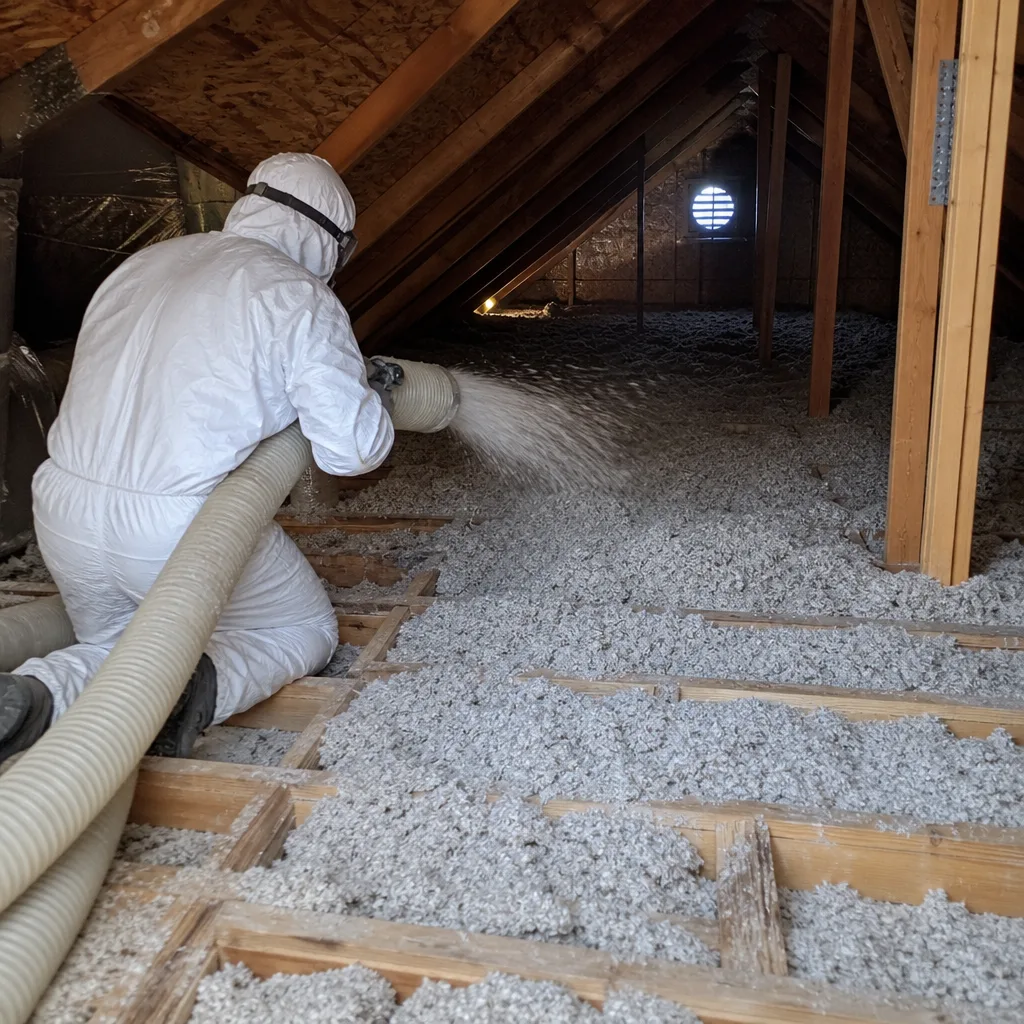
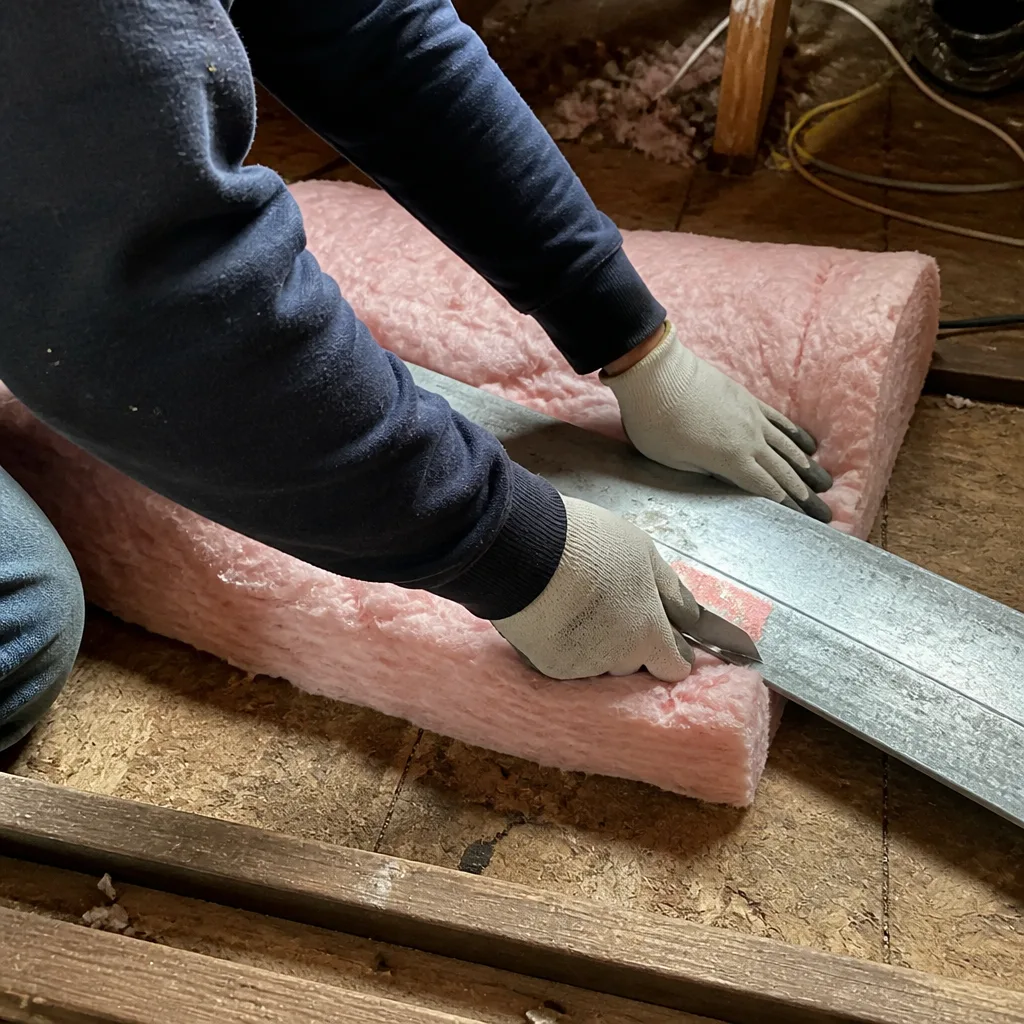
Available from manufacturers like CertainTeed and Johns Manville. Fiberglass is inexpensive, non-combustible, and doesn’t support mold growth on its own. Its elevated-temperature R-value retention is the weakest of the three categories, which is why that 8 – 12% reduction matters here. Dimensional stability is generally good in a dry attic, though fine glass fibers can settle over the first year, so installers should slightly over-blow the target depth to hit the specification after settling.
Blown Cellulose
Cellulose is typically 80 – 85% recycled paper fiber treated with fire retardants. Product like GreenFiber is common in Clark County. It has better elevated-temperature R-value retention than fiberglass and dense-packs well when installed at the correct density. The catch is moisture sensitivity: cellulose wicks water and, if a roof leak or condensation event goes unnoticed, it can hold that moisture against the attic floor. In a low-humidity desert that risk is smaller than in coastal climates, but it doesn’t disappear when a swamp cooler or an AC condensate line is running above the ceiling.
Spray Polyurethane Foam
Closed-cell and open-cell foam from manufacturers like Icynene or Demilec are the strongest performers on dimensional stability. Closed-cell foam expands and cures as a bonded, rigid mass that doesn’t settle, doesn’t sag, and air-seals the assembly as part of installation. That air-sealing property is significant in Las Vegas because the attic floor penetrations are the biggest source of conditioned-air loss. If you want the detail on how foam behaves in this climate, our spray foam insulation service in Las Vegas covers the closed-cell versus open-cell decision in more depth.
How the Three Compare
- Elevated-temperature R-value retention: Spray foam > cellulose > fiberglass.
- Dimensional stability (resistance to settling and sagging): Spray foam (bonded, rigid) > cellulose (dense-packed) > fiberglass (loose-fill, can settle).
- Moisture sensitivity in a desert climate: Fiberglass (least affected) > spray foam (closed-cell is moisture-resistant, open-cell is not) > cellulose (wicks and holds moisture if a leak develops).
- Air-sealing contribution: Spray foam (built in) > cellulose (partial) > fiberglass (none).
How to Read a Manufacturer’s Technical Data Sheet
A technical data sheet is the document that tells you what the product actually does. It’s typically 4 – 8 pages and organized predictably. Here’s what to look at, in order:
- Thermal performance table. Look for R-value per inch at each tested mean temperature, and the ASTM C518 reference.
- Settling or stabilization data. For loose-fill products, manufacturers report a settled density and post-settling R-value. If they don’t, treat the headline R-value as inflated by 5 – 10%.
- Moisture absorption and permeability. Look for water vapor permeance in perms and moisture absorption percentage. In Las Vegas these numbers matter most when a swamp cooler or AC condensate line is nearby.
- Fire performance. Flame spread and smoke developed ratings per ASTM E84. Most residential products meet Class A, but confirm.
- Code compliance references. Look for ICC-ES Evaluation Service Report numbers. These verify the product has been reviewed against building codes adopted in jurisdictions including Clark County.
- Installation requirements. Coverage charts, density requirements, and any accessory products the manufacturer mandates. A contractor skipping a required accessory is a red flag.
If a contractor’s proposal names a product but you can’t find the data sheet for that specific product SKU, that’s a brand-verification problem. We work with materials from Owens Corning, Johns Manville, Knauf, Rockwool, CertainTeed, Icynene, Demilec, and GreenFiber, with no proprietary lock-in, because the right pick for a Las Vegas home depends on the assembly, not on our supplier relationships.
What Third-Party Certifications Actually Verify
Certification logos appear on every insulation brochure. Most of them verify something narrow. Here’s what each one covers, and what it doesn’t:
- GREENGUARD and GREENGUARD Gold: Verify low chemical emissions for indoor air quality. They do not verify thermal performance, R-value accuracy, or installation quality.
- Intertek listing: Verifies the product sample tested matches the manufacturer’s claims for the tested properties. It does not verify how the product performs at temperatures outside the test protocol, and it doesn’t confirm every production run matches the tested sample.
- ICC-ES Evaluation Service Report (ESR): Verifies the product has been reviewed against the International Building Code and International Residential Code, and that the evaluation confirms compliance for the specified uses. This is the one that matters most for Las Vegas permitting, because Clark County adopts the IRC and inspectors look for the ESR number when a nonstandard product is used.
- UL classification: Verifies fire performance and, for foam products, sometimes verifies the product against specific UL standards for flame spread and smoke.
- ENERGY STAR certification: Applies to assemblies or products meeting efficiency thresholds. It’s a market signal, not a performance verification at local temperatures.
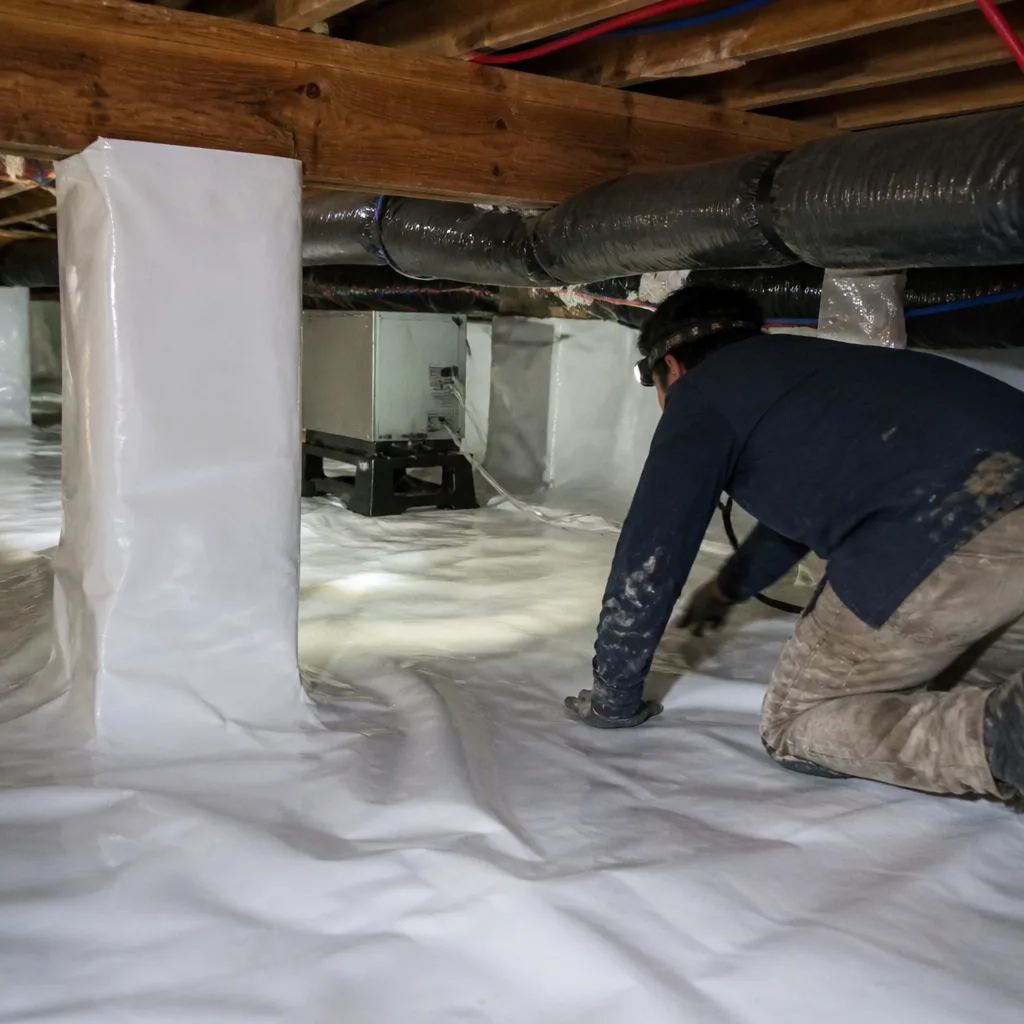
In practice, the certification most likely to matter on your Las Vegas permit is the ICC-ES report. The one most likely to be marketed to you is GREENGUARD. Neither one tells you what R-value you’ll get at an attic mean temperature of 115°F. That’s why we read the data sheet alongside the certification every time, and why our written scope for a crawl space encapsulation and vapor barrier project in Las Vegas names the material, the ESR number, and the tested properties.
The Brand-Agnostic Specification Approach
The most reliable way to buy insulation in Las Vegas is to write the specification by performance and leave the brand open. Here’s how that works:
- State the required R-value at a stated mean temperature (e.g., “R-38 minimum at a mean temperature of 110°F, documented per ASTM C518”).
- State the required dimensional stability (e.g., “settling not to exceed 2% of installed thickness after 12 months under typical attic conditions”).
- State the required moisture behavior (e.g., “water vapor permeance not to exceed 1 perm” for below-grade applications).
- Require the contractor to deliver the manufacturer’s material invoice and the data sheet for the installed product as part of closeout.
- Leave the brand decision to the contractor, subject to meeting the spec, with the invoice as the record of what was actually installed.
This approach protects you in three ways. You’re not locked into a brand you can’t verify. You get documentation you can use if a warranty claim ever comes up. And you can compare bids on the same spec instead of comparing names on bags. A written price before any work starts, with a written scope and a written warranty, is the whole foundation of how we operate. If a competing quote comes in, our free second opinion on any written estimate in Las Vegas is a standing offer: bring it in, and we’ll read the product spec next to the data sheet together.
Cross-Referencing a Contractor’s Recommendation Against the Data Sheet
Here are two real-world cross-reference examples of the kind of comparison a homeowner should be able to do themselves, using products commonly distributed in Clark County.
Example 1: CertainTeed Blown Fiberglass
CertainTeed publishes thermal performance for its blown fiberglass products at standard ASTM C518 mean temperatures. The homeowner should locate the R-value per inch at 75°F and check whether the data sheet includes a correction row at higher mean temperatures. Where only 75°F is published, the correction is estimated, and the contractor should say so. If the proposal says “R-38” without naming the mean temperature or the per-inch R at 110°F, the specification is incomplete.
Example 2: Icynene Spray Foam
Icynene closed-cell and open-cell products publish R-value per inch and typically also publish aged R-value, because foam off-gasses and settles into its long-term performance. The homeowner should confirm whether the proposal quotes the initial or aged value, and whether the assembly is closed-cell (which holds its R-value and adds structural rigidity) or open-cell (which is softer and moisture-permeable). In a Las Vegas attic with a radiant heat load, closed-cell is often the correct pick when the goal is elevated-temperature retention.
For a full run-through, our attic insulation work in Las Vegas walks through this comparison using the data sheets we keep on file. The point is that you can replicate any contractor’s brand recommendation by going to the manufacturer’s site directly. If the numbers don’t line up, you have a specific question to ask before signing.
Common Mistakes to Avoid
- Buying on the headline R-value. The number on the bag at 75°F is not the number your attic experiences in August. Always check the corrected R-value at elevated mean temperature.
- Insulating before air sealing. Blowing insulation over an unsealed attic floor traps conditioned air in the wrong places and hides leaks from future inspections. Air sealing top plates, can lights, and penetrations comes first, always.
- Trusting a brand name without a data sheet. Even a well-known brand has multiple product SKUs with different performance. Ask for the specific product datasheet, not the brand website homepage.
- Ignoring settling on loose-fill fiberglass. Fiberglass can settle 5 – 10% in the first year. If the contractor didn’t account for settling depth, the attic will be under-insulated by the following summer.
- Choosing cellulose without checking the roof and condensate lines. In a Las Vegas attic with a swamp cooler or an AC condensate line above the ceiling, cellulose can absorb water it shouldn’t have touched. Check the assembly before you pick the material.
- Accepting a verbal brand promise. “We’ll use the good stuff” is not a specification. The invoice should name the exact product, with the R-value at the stated mean temperature.
- Skipping the blower-door reading. A pressurization test before and after work shows, in one number, how much conditioned air the envelope is losing. Without it, you have no way to verify what you paid for.
These mistakes are why we schedule a blower-door test on applicable jobs and publish the readings in the closeout documentation. If you want to see the numbers we use, our attic insulation page for Las Vegas shows the before-and-after pattern that comes out of a sealed-first assembly.
When to Call a Professional
Some insulation decisions are DIY-appropriate. Brand selection for a Las Vegas attic is not one of them. The attic assembly has too many interacting parts, and the failure modes in Southern Nevada heat are specific. Call a professional when you’re deciding between products, when your attic has a radiant heat load above 130°F, when the roof has been replaced in the last five years (fastener and flashing details matter), when a swamp cooler or AC condensate line is present, when the previous insulation is rodent-contaminated, or when you can’t verify the installed product against the manufacturer’s data sheet. A licensed contractor carries the material warranties, produces the ESR documentation for permitting, and documents the result with a blower-door reading. Envelope Insulation Las Vegas offers free estimates in Las Vegas – call (833) 362-4859 to schedule one, and we’ll come with a written price and a written scope before anyone lifts a tool.
Frequently Asked Questions
The “best” brand is the product that meets your stated R-value at the attic’s real mean temperature, holds its dimensions through daily temperature swings, and suits the moisture behavior of your assembly. For most Las Vegas attics, that means comparing the technical data sheets for a specific blown fiberglass, blown cellulose, and spray foam product rather than comparing brand logos. CertainTeed, GreenFiber, Icynene, and Demilec all publish the data you need; the right pick depends on your assembly, not the manufacturer.
Most attic insulation projects in a typical Las Vegas single-family home run $1,800 to $4,500 depending on the attic square footage, the R-value target, and whether air sealing is included. Brand changes the material cost by roughly 10 – 25% within a category, but the labor and air-sealing work are usually the larger cost drivers. Call (833) 362-4859 for a written price specific to your home before any work starts; estimates are free.
Spray foam wins on elevated-temperature R-value retention and dimensional stability; blown fiberglass wins on cost and moisture tolerance. For most Las Vegas attics under a radiant heat load, closed-cell spray foam is the stronger performer on the metrics that matter, but the decision should be based on your attic assembly, not a blanket recommendation. Bring us your contractor’s written estimate and we’ll read it against the data sheets with you.
The ICC-ES Evaluation Service Report is the certification most likely to matter on a Clark County permit, because it verifies compliance against the International Residential Code that inspectors reference. GREENGUARD verifies indoor air quality, and Intertek verifies that the tested sample matched the manufacturer’s claims. None of these certifications verify thermal performance at elevated mean temperature, so you still need the data sheet.
Often, yes. We schedule attic inspections same-day or next-day for most Las Vegas addresses, with a written price before any work starts and a written scope and warranty in hand before we leave. Call (833) 362-4859 and a live person will answer; we don’t route calls to voicemail, seven days a week.
A brand-agnostic spec states the required performance (R-value at a stated mean temperature, dimensional stability, moisture behavior) and leaves the product choice open. A brand-specific spec names the product. For a Las Vegas attic, the brand-agnostic approach is more reliable because it lets you verify the result against the data sheet regardless of which brand gets installed, and it prevents the contractor from substituting a cheaper product that doesn’t meet the spec. Our written scopes are always brand-agnostic; the invoice documents what was actually installed.
The Bottom Line
Insulation brand selection in Las Vegas should come down to two numbers: the corrected R-value at your attic’s actual mean temperature, and the product’s dimensional stability through daily 90°F cycles. Mean temperature correction is published in every manufacturer’s technical data sheet and rarely appears in a sales presentation. The three product categories used in Las Vegas attics each win on a different criterion, and third-party certifications verify narrow claims, not performance at desert temperatures. Spec the job by performance, require the material invoice and data sheet at closeout, and verify the result with a blower-door reading. That’s the whole framework. Call (833) 362-4859 for a free estimate, and we’ll walk through the data sheet with you before we talk about brand.
Written by the team at Envelope Insulation Las Vegas.