
Last updated November 17, 2026
How Long Does Spray Foam Insulation Take? Timelines and What to Expect
A 2,000-square-foot attic can be sprayed in under four hours. The homeowner still can’t re-enter for 24 hours, the HVAC can’t run during that same window, and if the substrate temperature was out of spec when the crew arrived, that four-hour spray time doesn’t matter at all – the job has to be redone. That gap between the number quoted in an estimate and the number the homeowner actually plans their week around is where most scheduling conflicts start. This guide breaks down spray foam insulation timelines phase by phase, explains why Las Vegas summers change the math, and gives you a written record to check the work against.
Quick Answer
Most residential spray foam projects take 1 to 4 hours of actual spray time for an attic or crawl space, but plan on a full day from arrival to wrap-up once prep, temperature checks, and thickness verification are included. Add a 24-hour re-entry window after closed-cell foam and a possible staged application if lifts exceed 2 inches. In Las Vegas, summer substrate temperatures and HVAC lockout during cure extend the total project by several hours compared to a spring install.
Table of Contents
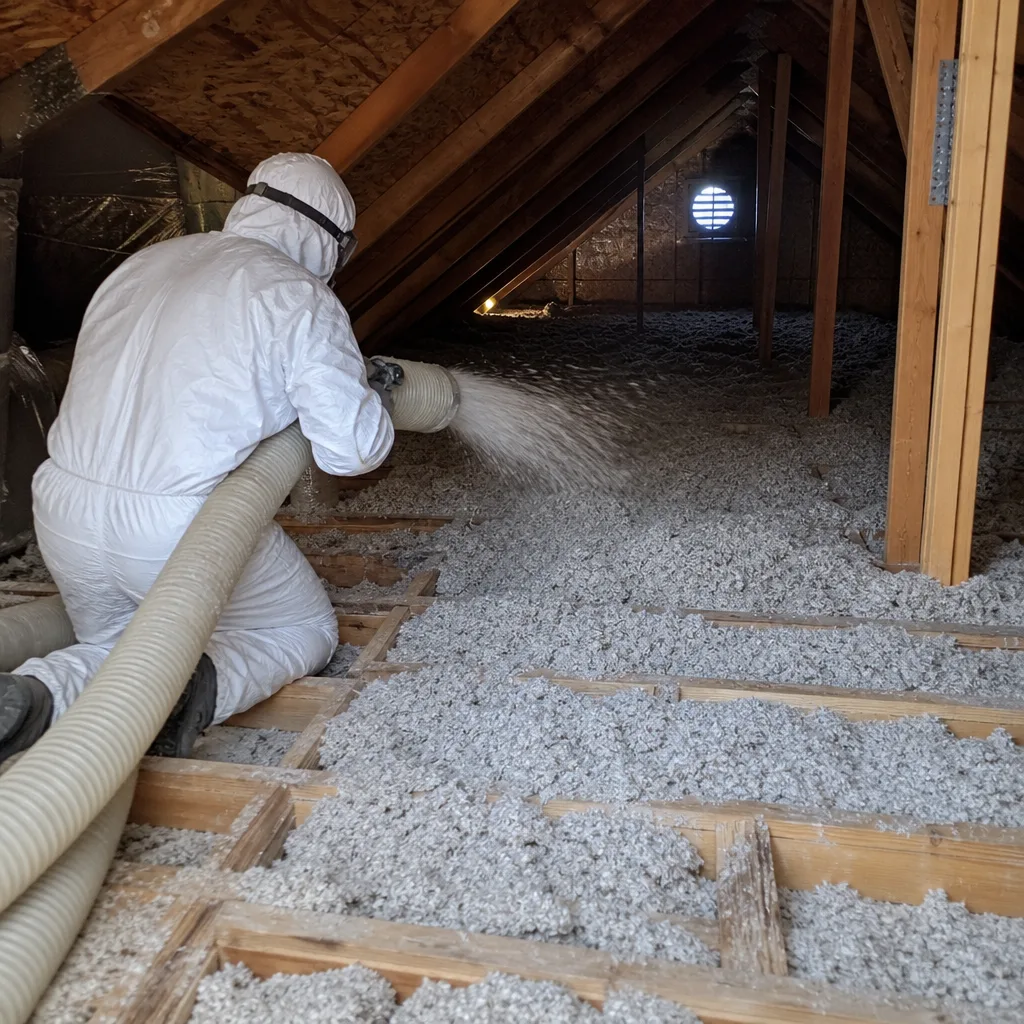
- The Time Budget: Spray Time vs. Total Project Time
- Why Las Vegas Summers Stretch the Timeline
- What 24-Hour Re-Entry Actually Means
- Multi-Lift Timing for Closed-Cell Foam
- How Long Does Spray Foam Insulation Cost in Las Vegas?
- Can Spray Foam Be Done in One Day?
- The Written Checklist for Job Close
The Time Budget: Spray Time vs. Total Project Time
When a contractor says “about four hours,” they usually mean spray time. That figure omits every phase that determines whether you can sleep in the house that night. Here’s how an actual project budget runs on a typical Las Vegas attic job – a 1,500-to-2,000-square-foot single-story home built between 2015 and 2025.
- Arrival and substrate inspection (30 to 60 minutes). The crew walks the space, checks for moisture, rotted sheathing, active leaks, knob-and-tube wiring, and anything that would stop the job. This is also when the ambient temperature and substrate temperature get logged.
- Masking and prep (30 to 90 minutes). Windows, vents, and HVAC equipment get protected. Penetrations and top plates get sealed before any foam is applied – air sealing happens before insulation, in that order.
- Temperature conditioning wait (0 to 3 hours, weather dependent). Spray foam has a substrate temperature range where it cures correctly. When the deck is outside that range, the crew waits, runs conditioned air, or reschedules. This is where the four-hour estimate falls apart in July.
- Spray time (1.5 to 4 hours). Depends on square footage, foam type, and target R-value. Open-cell sprays faster per inch; closed-cell achieves more R-value per inch but sprays slower and denser.
- Cure window (15 to 60 minutes before re-entry to the space; 24 hours before occupied use of the home for closed-cell). The crew cannot verify thickness while foam is still off-gassing and expanding.
- Thickness verification and cleanup (30 to 45 minutes). Depth gauge checks at multiple points, trimmed excess, photo record, walkthrough with the homeowner.
Total project time from arrival to departure on a Las Vegas job: 6 to 10 hours in mild weather, 8 to 12 hours in summer. Spray time is 20 to 40 percent of that window. If a quote gives you a number and stops there, ask which phase it’s describing.
Why Las Vegas Summers Stretch the Timeline
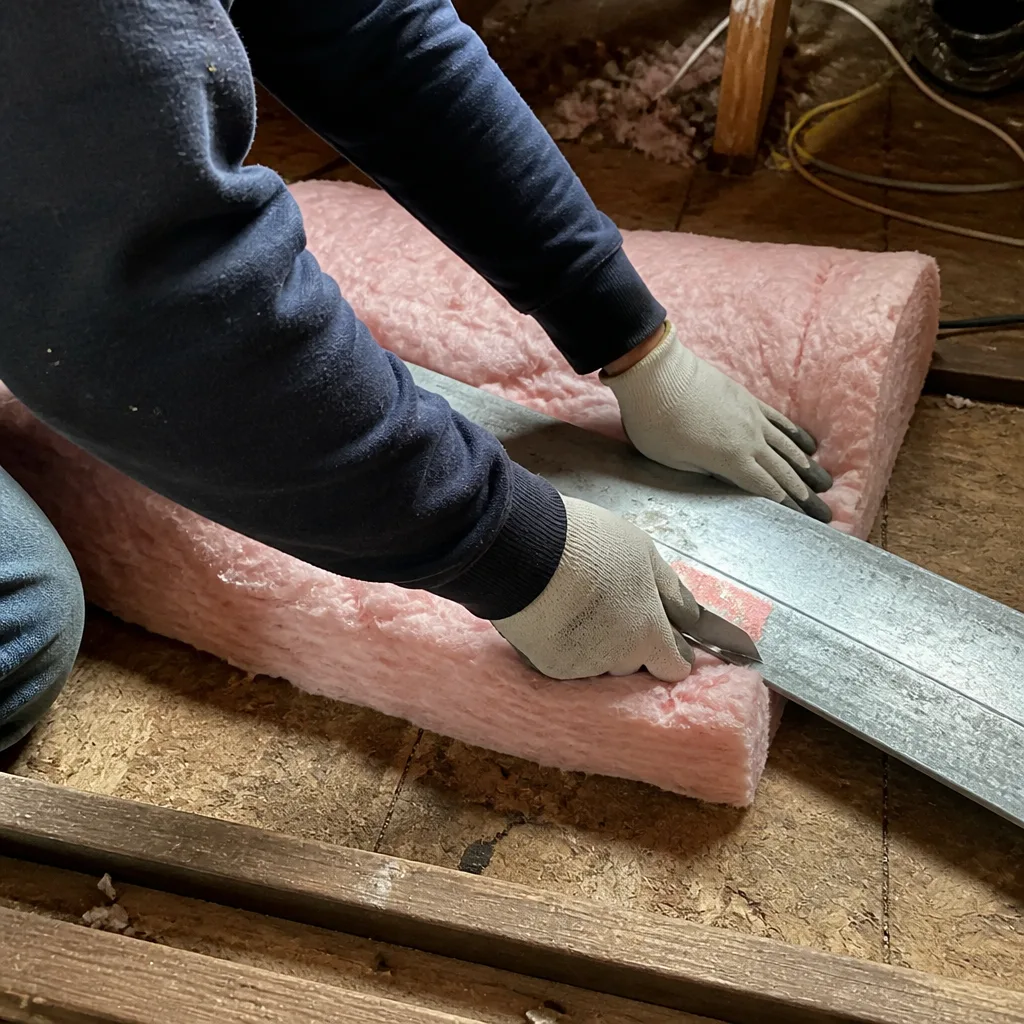
Substrate temperature is the single biggest variable most homeowners never hear about. Closed-cell foam – the Icynene and Demilec formulations we spray most often in Las Vegas attics – has a recommended substrate range that tops out around 85 to 90°F for reliable adhesion and expansion. When the roof deck reads 130°F at 2 p.m. in July, that range is nowhere close.
Substrate temperatures above 90°F at time of spray affect closed-cell expansion rates. Foam that cures too fast on a hot substrate doesn’t adhere properly, forms voids, and can delaminate within a season. We’ve seen it in Summerlin and Green Valley attics where a previous crew sprayed at midday and called it done. The fix on our jobs is one of three things:
- Early-morning start times. Crew on site at 5:30 or 6 a.m., spray begins before the deck heats up. The whole project shifts earlier – which means the homeowner needs to be out of the house by 5 a.m., not 9.
- Conditioned workspace. Portable cooling brought in to bring the attic down to spec. Adds 2 to 4 hours to the front of the job and shows up on the price.
- Seasonal reschedule. April, May, October, and early November are the sweet spot in Las Vegas. If we can move a summer install into that window, everyone saves time and foam performs better long-term.
This is the practical reason a “four-hour job” becomes an eight-hour day in Las Vegas between June and September. It isn’t upselling – it’s physics. See our Spray Foam Insulation in Las Vegas page for how we schedule around the heat.
What 24-Hour Re-Entry Actually Means
The 24-hour re-entry rule for closed-cell foam isn’t a suggestion. It means no occupants in the home – not working, not sleeping, not letting the dog in. It also typically means the HVAC stays off during the initial cure so foam can set without airflow disturbance. On a 110°F Las Vegas day, that produces a house temperature rise most families aren’t prepared for.
Here’s what the protocol looks like in practice:
- Before the crew leaves: windows and doors opened for ventilation per the product’s safety data sheet, HVAC locked out at the thermostat.
- Hours 1 to 4 post-spray: primary off-gassing window. Interior temperature climbs fast in summer without AC.
- Hours 4 to 24 post-spray: foam fully cures. No one enters the space except to ventilate if the schedule allows.
- Hour 24: re-entry permitted, HVAC restored, smell may persist faintly for another day or two.
In summer, plan for the house to sit at 90 to 100°F inside before the HVAC comes back on. That means eating out, staying with family, or booking a hotel. It’s the honest part of the timeline that rarely makes it into the estimate.
What proves the cure window was respected? Documentation. A crew that logs ambient temperature and HVAC lockout time on the job report gives you a record if you ever need to make a warranty claim. Under Haven Standard, a written scope, written warranty, and Documented Photo Record are delivered before anyone starts and after the crew leaves – every visit, not on request.
Multi-Lift Timing for Closed-Cell Foam
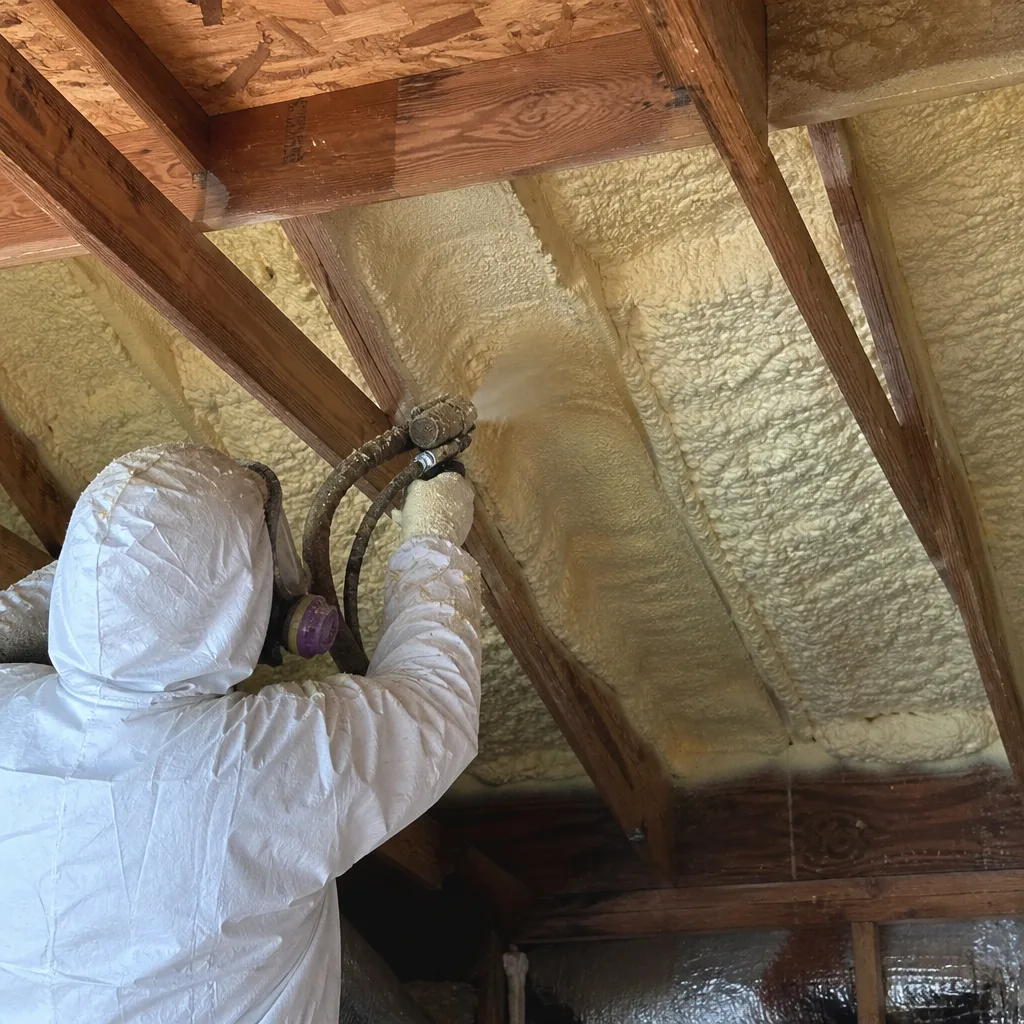
Closed-cell foam goes on in lifts, and lifts are capped at roughly 2 inches per pass. That’s a manufacturer limit, not a crew preference. The reason is exothermic heat – the chemical reaction that cures the foam generates heat, and thick single passes trap that heat in the middle of the layer. The result is scorched or bubbling foam, delamination from the deck, and a failed install that has to be removed and redone.
Multi-lift timing on a typical Las Vegas attic looks like this:
- Lift 1: 2 inches throughout, roughly 45 to 90 minutes depending on square footage.
- Cooling interval: 30 to 90 minutes per lift so the surface temperature drops back into range. In summer, longer. In a cold crawl space, shorter.
- Lift 2: second 2 inches applied, same cooling interval.
- Lift 3 (if needed for target R-value): final pass, then full cure window.
A 2-inch closed-cell job on 1,800 square feet (R-13 to R-14) is a single lift. A 4-inch job at R-26 is two lifts with a cooling interval – adding 1 to 2 hours. A 6-inch job in a hot attic can add 3 to 4 hours. Open-cell jobs are simpler; they aren’t usually limited to 2-inch lifts and can usually go on in one or two passes. If you’re comparing a closed-cell quote to an open-cell quote and the timelines look the same, ask why. They shouldn’t.
You can read more about how we handle lifts, materials, and climate in our Attic Insulation in Las Vegas guide.
How Long Does Spray Foam Insulation Cost in Las Vegas?
Cost and time are related – multi-lift jobs, conditioned-workspace jobs, and summer early-morning jobs all run longer and cost more. Here’s how the numbers typically land in the Las Vegas market for a residential attic or crawl space installation.
| Scope | Typical Las Vegas Range | Time Added vs. Baseline |
|---|---|---|
| Open-cell attic, 1,500-2,000 sq ft, R-13 to R-20 | $1,800 – $3,200 | Baseline |
| Closed-cell attic, single lift, R-13 to R-14 | $2,400 – $4,200 | +1 to 2 hours (slower spray, cure wait) |
| Closed-cell attic, two lifts, R-26 | $4,000 – $7,200 | +2 to 4 hours (cooling interval) |
| Closed-cell attic, three lifts, R-38+ | $5,800 – $9,800 | +3 to 5 hours (two cooling intervals) |
| Crawl space rim joist + walls, closed-cell | $2,200 – $4,800 | +1 to 3 hours |
| Conditioned-workspace summer surcharge | $300 – $800 | +2 to 4 hours |
Every one of those ranges assumes air sealing comes first. In a Las Vegas attic built post-2015, we routinely find top plates, can lights, and plumbing penetrations leaking enough air that foam over the top is wasted. Sealing before spraying is the whole reason our before-and-after blower-door readings (a pressurization measurement that shows, in one number, how much air your envelope is losing) move the way they do. Our Envelope Insulation home page goes deeper into that process. Prices move with material cost and access difficulty; a written price before any work starts is what you should expect regardless of the range.
Can Spray Foam Be Done in One Day?
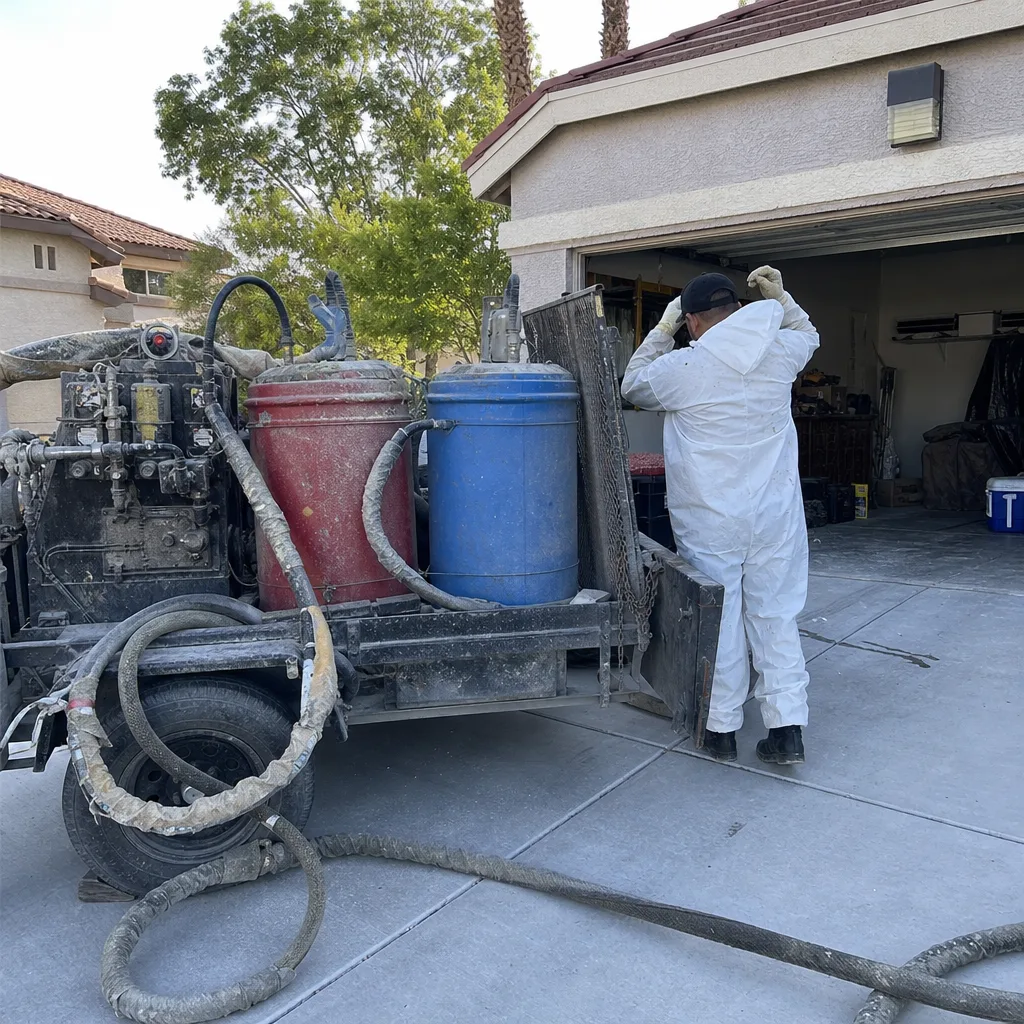
Yes, most residential spray foam jobs in Las Vegas finish in a single day – arrival to departure. What “done” means matters. The crew is out the same afternoon; the home is not occupiable until the 24-hour closed-cell cure window clears.
Single-day completion depends on four things lining up:
- Substrate already in spec. Cooler months make this easier. Summer mornings require early scheduling.
- No moisture issues discovered on inspection. An active roof leak or crawl space moisture stops the job until it’s addressed.
- Lifts planned correctly. A two-lift job can still finish same-day; a four-lift job through a large attic might not.
- Access is straightforward. Attic hatches, knee walls, and ductwork all add labor time; some homes need a second day simply to navigate the space safely.
When we quote a Las Vegas job, we tell you at the estimate stage whether it’s a one-day project. If it’s two days, you know why: usually a multi-lift closed-cell install or a combined air-sealing and foam scope on an older home. There’s no surprise morning-of call changing the plan.
The Written Checklist for Job Close
The timeline record is only as good as the paperwork behind it. When the crew pulls out of your driveway, here’s what should be in your hands or attached to your job folder:
- Installed thickness measurements at multiple points. Not a single reading – depths checked at the corners, mid-span, and the deepest pocket of the space. Foam is applied to a target thickness; the check confirms it.
- Ambient and substrate temperature log. Time of arrival, time of spray, substrate temp at start and again at the end of each lift.
- Product lot numbers. From the drums and from the spray gun system. This is how a manufacturer warranty claim is validated if there’s ever a defect.
- Lift timing record for closed-cell. When each lift went on and how long the cooling interval ran.
- HVAC lockout and re-entry times. The exact clock time the HVAC was disabled and when re-entry is permitted.
- Before-and-after blower-door readings. Baseline CFM50 before air sealing, and after. A single figure that shows what changed.
- Documented Photo Record. Pre-work, in-progress, post-work, thickness verification, and moisture findings – included on every job, not available on request.
Compare this against whatever your contractor hands you. If the folder is thin, ask for the missing items in writing – the request itself is a useful test.
Common Mistakes to Avoid
- Booking a summer install months in advance without a temperature plan. A July slot in Las Vegas needs either a 5 a.m. start or a conditioned workspace on the quote. If neither is discussed, the crew will either spray out of spec or lose a day rescheduling.
- Assuming the quoted spray time is the day’s total. Four hours of spray can mean ten hours of project. Book the day off, not the morning.
- Scheduling HVAC service the same day as the foam install. The system won’t be running by the time the HVAC tech arrives. Push any HVAC service to the day after re-entry.
- Skipping the 24-hour closed-cell window because the house feels fine. Off-gassing and full cure don’t follow the “smells done” logic. Wait the full window.
- Letting a crew spray over unsealed top plates and penetrations. This is the single most common waste of foam dollars we see on second-opinion jobs in Las Vegas – and the hardest to correct once the foam is in.
- Rushing closed-cell lifts to save time. A 2-inch lift applied at 4 inches because the crew is behind schedule produces delamination. You can’t see it from the ladder; you feel it in year three when attic performance drops.
- Accepting a job close with no thickness log and no lot numbers. If there’s ever a warranty conversation, the missing paperwork turns a straightforward claim into a fight.
When to Call a Professional
Spray foam is not a homeowner-level project, and we’re direct about that. The two-part chemistry, the substrate temperature requirements, the exothermic chemistry of closed-cell lifts, and the safety equipment for confined-space spray all require trained hands. If any of the following applies, it’s time to call:
You’ve got an attic with visible daylight or known air leaks around can lights and top plates; you’re seeing moisture or condensation on the roof deck; you’re comparing two written estimates and the timelines don’t match; you’ve had foam installed elsewhere in the home and are concerned about how it was sprayed; or you’re planning a Las Vegas summer install and want a schedule that accounts for substrate temperature before the truck shows up. Envelope Insulation Las Vegas offers free estimates in Las Vegas – bring us any competing written quote and we’ll read it with you. Call (833) 362-4859 – a live person answers 24/7.
If you’re also thinking about the crawl space or rim joists alongside the attic, our Crawl Space Encapsulation & Vapor Barrier in Las Vegas guide covers the timelines for that work and how it bundles with an attic install.
Frequently Asked Questions
Spray time alone is 1 to 4 hours for a typical Las Vegas attic, but total project time from arrival to departure is 6 to 10 hours in mild weather and 8 to 12 hours in summer once prep, temperature conditioning, cooling intervals for multi-lift closed-cell, and thickness verification are included. Add a 24-hour re-entry window for closed-cell foam before occupying the home. Call (833) 362-4859 for an exact project timeline on your home – the estimate is free and comes with a written scope.
Yes, for closed-cell foam. The home should be vacant from spray start through the 24-hour cure window, and the HVAC typically stays off during that period. In a Las Vegas summer, the interior will heat up substantially during that lockout, so plan an overnight elsewhere. Open-cell jobs have shorter occupancy limits, but the crew’s specific product data sheet governs – ask at the estimate stage.
Yes, with adjustments. Substrate temperatures above 90°F affect closed-cell expansion and adhesion, so we either start crews at 5:30 or 6 a.m., bring portable cooling to condition the attic, or reschedule to a cooler month. Expect the total project to run 2 to 4 hours longer than the same job in October or April. Call (833) 362-4859 for a summer scheduling window – estimates are free.
HVAC is typically restored after the 24-hour closed-cell cure window clears. The system stays locked out because airflow disturbs the initial cure. If you’re scheduling other trade work in the same week, put HVAC service the day after re-entry, not the same day. For a written timeline that shows lockout and restoration on the calendar, call (833) 362-4859.
A 2,000-square-foot attic takes about 2 to 4 hours of actual spray time for open-cell or single-lift closed-cell, and 4 to 7 hours for two-lift closed-cell once the cooling intervals are included. Total project day runs 6 to 11 hours depending on month. Homeowners in Summerlin, Green Valley, and Henderson frequently ask for this number – and it’s a fair question. Get a written price and a written schedule together by calling (833) 362-4859.
Not universally – it depends on the assembly. Spray foam air-seals and insulates in one pass and performs better in rim joists and irregular cavities. Blown-in, like Owens Corning or GreenFiber loose-fill, is often the better choice for flat attic floors where air sealing is already done. The right answer starts with a blower-door test. Call (833) 362-4859 to book one with a written price before any work starts.
The Bottom Line
Spray foam insulation takes 1 to 4 hours of spray time and 6 to 12 hours of total project time, plus a 24-hour closed-cell re-entry window. In Las Vegas, summer heat adds hours through early-morning scheduling, conditioned workspaces, and longer cooling intervals between closed-cell lifts. The number that matters isn’t the spray time – it’s the total day and the documentation that proves the job was done within spec. Every Envelope Insulation Las Vegas job starts with a written price, written scope, and written warranty, and ends with a Documented Photo Record plus before-and-after blower-door readings on applicable installs. Under the 365-Day Done Right Promise, if it’s not right, we make it right. Have a written estimate from another contractor? Bring it in for a free second opinion – we’ll read it with you.
Call (833) 362-4859 for a free estimate on your Las Vegas spray foam project. A live person answers, day or night. Our technicians have up to 10 years of experience, and every estimate includes a written price before any work starts – no exceptions.
Written by the team at Envelope Insulation Las Vegas.