
Top Signs You Need Insulation Service – Don’t Ignore These
The most reliable signs you need insulation service in Las Vegas aren’t high bills or uneven rooms. Those are lagging indicators, showing up a year or more after the envelope started failing. The real signals are measurable: an attic running 30°F hotter than the outdoor air at noon in July, visible air paths at the top plates, HVAC run-time past 12 – 14 hours a day in summer. If you’d rather not crawl through a 140°F attic to check, call (833) 362-4859 and we’ll read the numbers for you.
Prefer to check things yourself first? Good. Here’s what actually matters, and what each sign is telling you.
Leading vs. Lagging Indicators: Why Your Bill Is the Last Thing to Notice
A utility bill that climbs 18% year-over-year in a Las Vegas home is a lagging indicator. The failures behind it were measurable 18 months earlier. By the time the bill is bad enough to prompt a call, the HVAC system has absorbed thousands of dollars in unnecessary run-hours, and the compressor has taken wear that no insulation job can undo.
Leading indicators show up on instruments, not on your statement:
- Attic temperature delta – the gap between your attic floor reading and outdoor ambient, taken at midday.
- Visible attic bypasses – gaps where air moves between conditioned and unconditioned space, especially at top plates and around can lights.
- HVAC run-time – exceeding 12 to 14 hours a day in July means the system is fighting the envelope, not the heat.
- Blower-door readings – CFM50 and ACH50 numbers that quantify leakage in a way a visual inspection never can.
Lagging indicators (high bills, uneven room temperatures, rooms that never cool) are what most homeowners notice first. They’re real. They’re just late. In our experience across Las Vegas, the homes that hurt most are the ones where nobody measured anything until the second summer of high bills. The Envelope Insulation Las Vegas home page lays out what a full envelope assessment covers if you want the wide view.
How to Read Your Attic Temperature at Noon in July
Grab a non-contact infrared thermometer (about $25 at any hardware store) and take three readings at solar noon: outdoor ambient in the shade, the attic floor surface near the center, and the attic air near the ridge. Write them down.
What the delta tells you:
- Attic air 30 – 40°F above outdoor ambient – normal for a Las Vegas attic. Radiant gain from a sun-baked roof deck is expected, and the attic floor insulation is doing the job it can.
- Attic floor surface within 5 – 10°F of outdoor ambient at noon – the insulation is resisting heat transfer. This is the outcome you want.
- Attic floor surface 15°F or more above outdoor ambient – insulation is compressed, displaced, or missing. Radiant gain is coming straight through.
- Floor readings that vary widely across the attic (10°F+ swing between two spots a few feet apart) – you likely have compressed fiberglass or air movement washing through the material in one zone.
A July attic in Las Vegas routinely hits 140°F or higher near the ridge. That’s a genuinely dangerous workspace. Take the readings from a safe standing point near the access hatch, and let a trained technician do any actual inspection. Our technicians have up to 10 years of experience working in that heat, and that matters.
The Visual Signs in a Las Vegas Attic That Actually Mean Something
An insulation inspection isn’t a quick glance from the hatch. The signs that pay attention to are specific, and most homeowners miss all three.
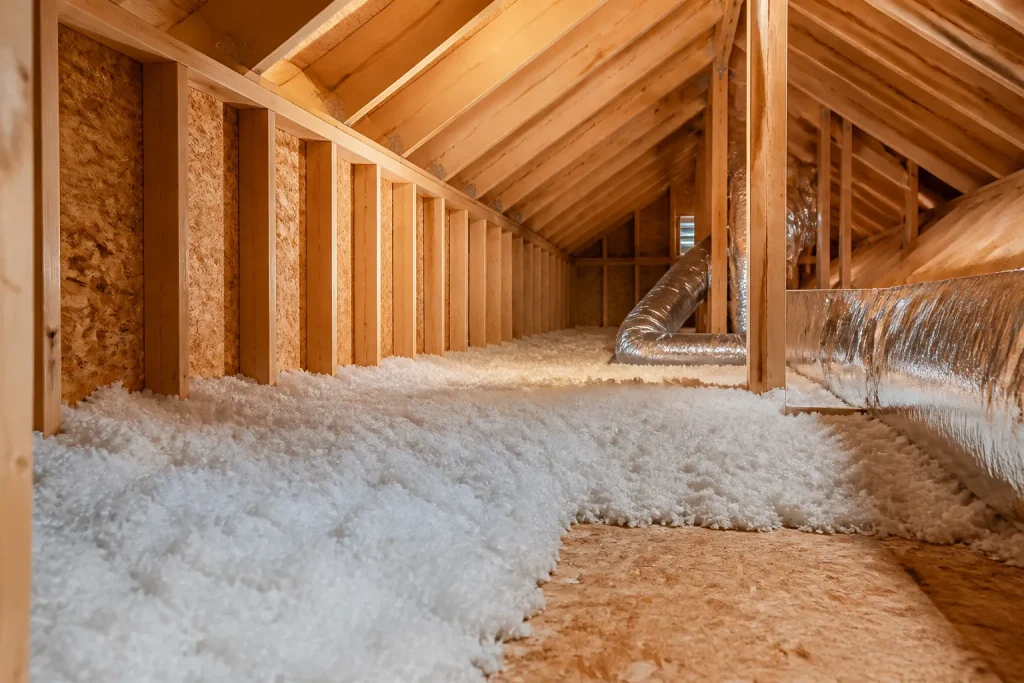
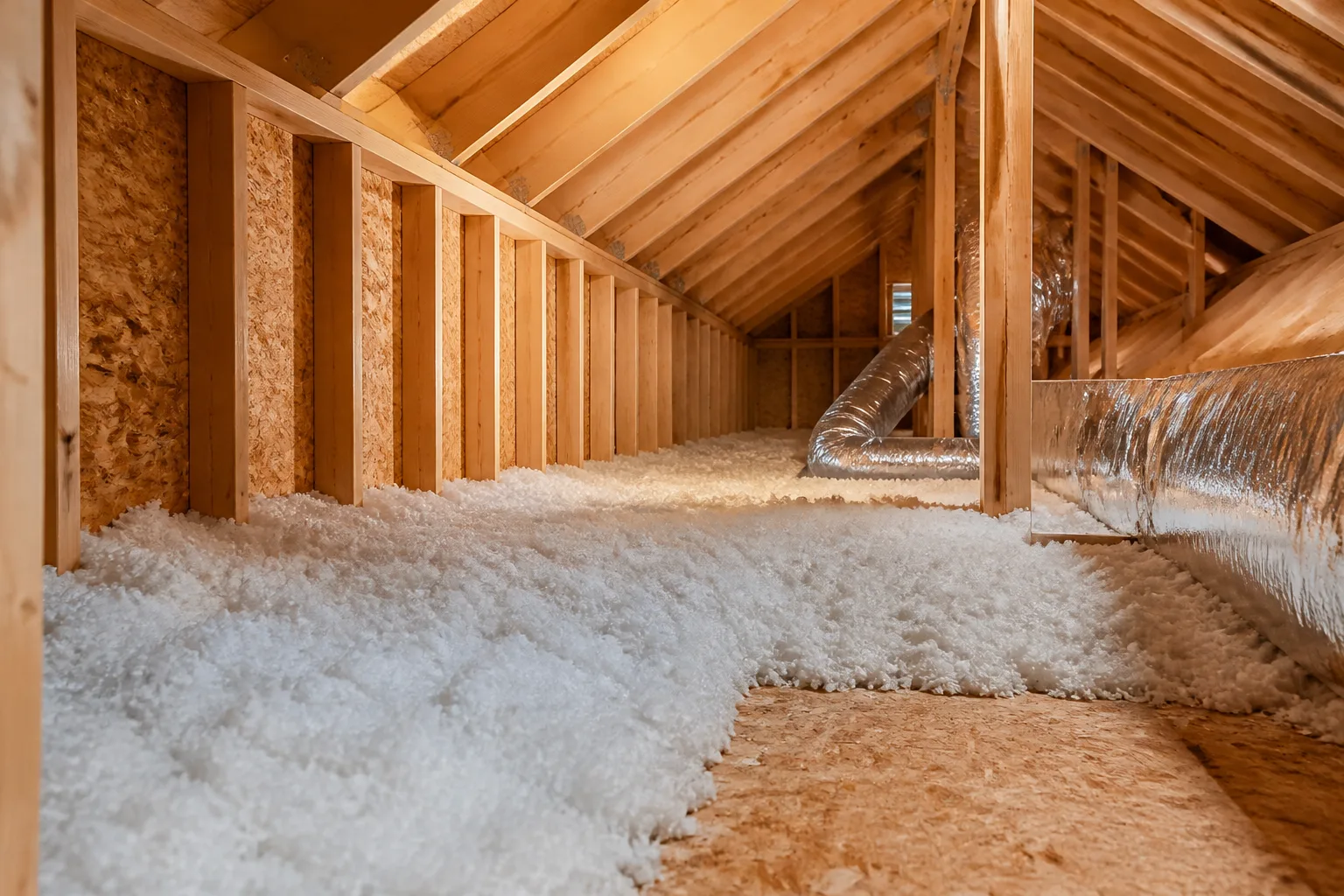
- Compressed fiberglass. Fiberglass loses roughly 1 R-value per inch of compression. Batts crushed under stored boxes, compressed by foot traffic, or blown too thinly in low spots are underperforming by design. In a Las Vegas attic with a 140°F ceiling, that lost R-value is money leaving the house.
- Dark staining on the insulation surface. A dark, dusty film on top of the insulation indicates air movement through the material itself, not just around bypasses. It’s the visible evidence of the envelope leaking.
- Displaced batt edges at truss intersections. Batts cut short or pushed aside where trusses cross are the single most common defect we see. Each gap is a thermal bridge letting attic heat radiate down through the ceiling drywall.
Two more worth knowing. Missing or incorrectly installed baffles at the eaves let wind wash insulation away. And pest activity isn’t just visible nesting material: compressed tunneling paths through blown insulation create thermal short circuits, channels where heat moves straight down through the material to the ceiling below.
One thing that doesn’t fix any of this: adding insulation on top of an unsealed attic floor. Under The Haven Standard Clause 1, we won’t do it. Air sealing at top plates, can lights, and penetrations comes first. Insulation comes second. Attic Insulation in Las Vegas covers the full process, including what a proper air-sealing prep looks like.
What a 10-Minute Blower-Door Snapshot Reveals That a Visual Inspection Can’t
A visual inspection tells you what’s compressed. A blower-door test tells you what’s leaking and by how much. Even a 10-minute preliminary snapshot – just the fan set in a door, the pressure gauge dialed to 50 pascals, one reading taken – gives a number that turns “probably leaking” into “leaking 3,400 CFM50.”
The two numbers to know:
- CFM50 – cubic feet per minute of air moving through the envelope at 50 pascals of pressure. It’s the raw leakage number. Lower is better. A tightly sealed Las Vegas home should land well below where most pre-sealing homes sit.
- ACH50 – air changes per hour at 50 pascals. This is the same measurement expressed as how many times the full volume of indoor air would be replaced in an hour at that pressure. It lets you compare homes of different sizes.
What this catches that a visual inspection misses: leakage hidden behind finished drywall (top plates behind kitchen soffits, ceiling penetrations behind fixtures), aggregate leakage from hundreds of hairline gaps that add up, and leakage through the insulation itself when air movement is washing the material. You’ll also see the effect on the HVAC system: a leaky envelope means the return duct is pulling attic air through it, and no amount of cooling equipment can fix that.
We publish before-and-after blower-door readings on every applicable job. Not as a marketing flourish – as the number that shows you what you actually paid for. If you’re curious what your home reads, the Spray Foam Insulation in Las Vegas page explains the scenarios where foam makes more sense than blown-in, especially in vented crawlspaces and rim joists.
When to Call a Pro (and What You Can Check Yourself)
You can safely check two things yourself: your HVAC run-time from a smart thermostat’s history, and the attic floor temperature from a standing point near the hatch. If run-time exceeds 12 – 14 hours a day in July, or the attic floor surface reads 15°F hotter than outdoor ambient at noon, call a professional. Don’t crawl around the attic to chase it. Las Vegas attics hit 140°F+, and heat exhaustion sets in faster than people expect.
Also worth a call: any visible tunneling in the insulation, dark staining on the surface you can see from the hatch, or batt edges pulled away from trusses. These are signs, not DIY projects.
Related services in Las Vegas: if you’re dealing with moisture or pest intrusion under the floor, Crawl Space Encapsulation & Vapor Barrier in Las Vegas covers the subfloor envelope that gets overlooked in nearly every insulation conversation.
The Bottom Line
The signs that matter are measurable. Attic temperature delta at noon. HVAC run-time over 12 – 14 hours. Visible bypasses at top plates. Compressed fiberglass, dark staining on the insulation surface, displaced batt edges at trusses. Blower-door readings that turn “probably leaking” into a number. If any of these show up in your Las Vegas home, the envelope is telling you before your utility bill does. Don’t wait 18 months to act on it.
If you’re in Las Vegas and need help, Envelope Insulation Las Vegas offers free estimates – call (833) 362-4859. We’ll run a blower-door snapshot before we quote, hand you a written price before any work starts, and send you a Documented Photo Record on every visit. Under the 365-Day Done Right Promise, if it’s not done right, we make it right.
Frequently Asked Questions
The earliest signs are measurable, not visible on your utility bill: an attic floor surface reading more than 15°F above outdoor ambient at noon in July, HVAC run-time exceeding 12 – 14 hours a day in summer, and visible air paths at top plates or around can lights. High bills and uneven room temperatures come 12 – 18 months later. If you’re seeing any of these, call (833) 362-4859 for a free estimate.
Take three readings with a non-contact thermometer at solar noon: outdoor ambient, attic floor surface, and attic air near the ridge. If the attic floor reads within 5 – 10°F of outdoor ambient, the insulation is resisting heat transfer. If it reads 15°F or more above outdoor ambient, insulation is compressed, displaced, or missing. A blower-door test gives a second, more precise measurement. Call (833) 362-4859 to schedule a free second opinion on any written estimate – we’ll review it with you.
A blower-door test measures actual air leakage through the envelope, expressed as CFM50 (cubic feet per minute at 50 pascals) and ACH50 (air changes per hour). A visual inspection identifies visible defects; the blower door quantifies the leakage and catches hidden problems behind finished drywall that no visual inspection can find. Every applicable job we complete includes before-and-after readings so you can verify the improvement. Call (833) 362-4859 for a free estimate.
No – and this is the most common ordering mistake we see. Blowing insulation on top of an unsealed attic floor traps the leaks in place. Compressed fiberglass and bypasses at top plates continue to move air, and the added R-value performs well below its rating. Under The Haven Standard Clause 1, we seal first, then insulate. Call (833) 362-4859 for a free estimate and a written scope before any work starts.
Written by the team at Envelope Insulation Las Vegas.
Need Insulation Help?
Call Envelope Insulation Las Vegas - licensed & insured, here with fast after-hours help in Las Vegas.
(833) 362-4859