
Spray Foam Insulation: Repair or Replace? How Las Vegas Homeowners Decide
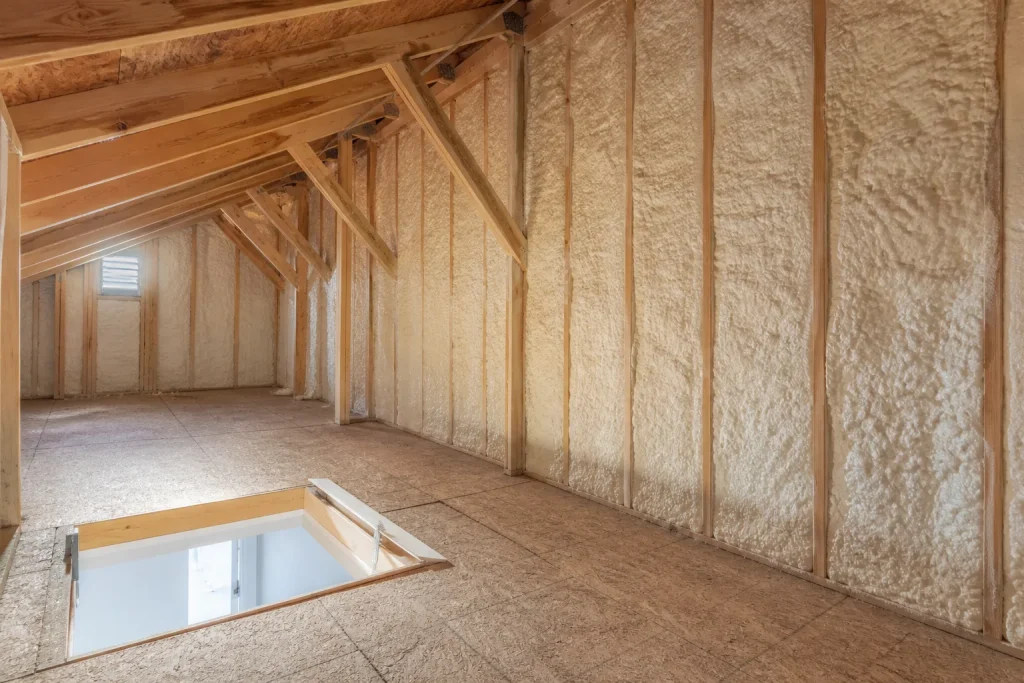
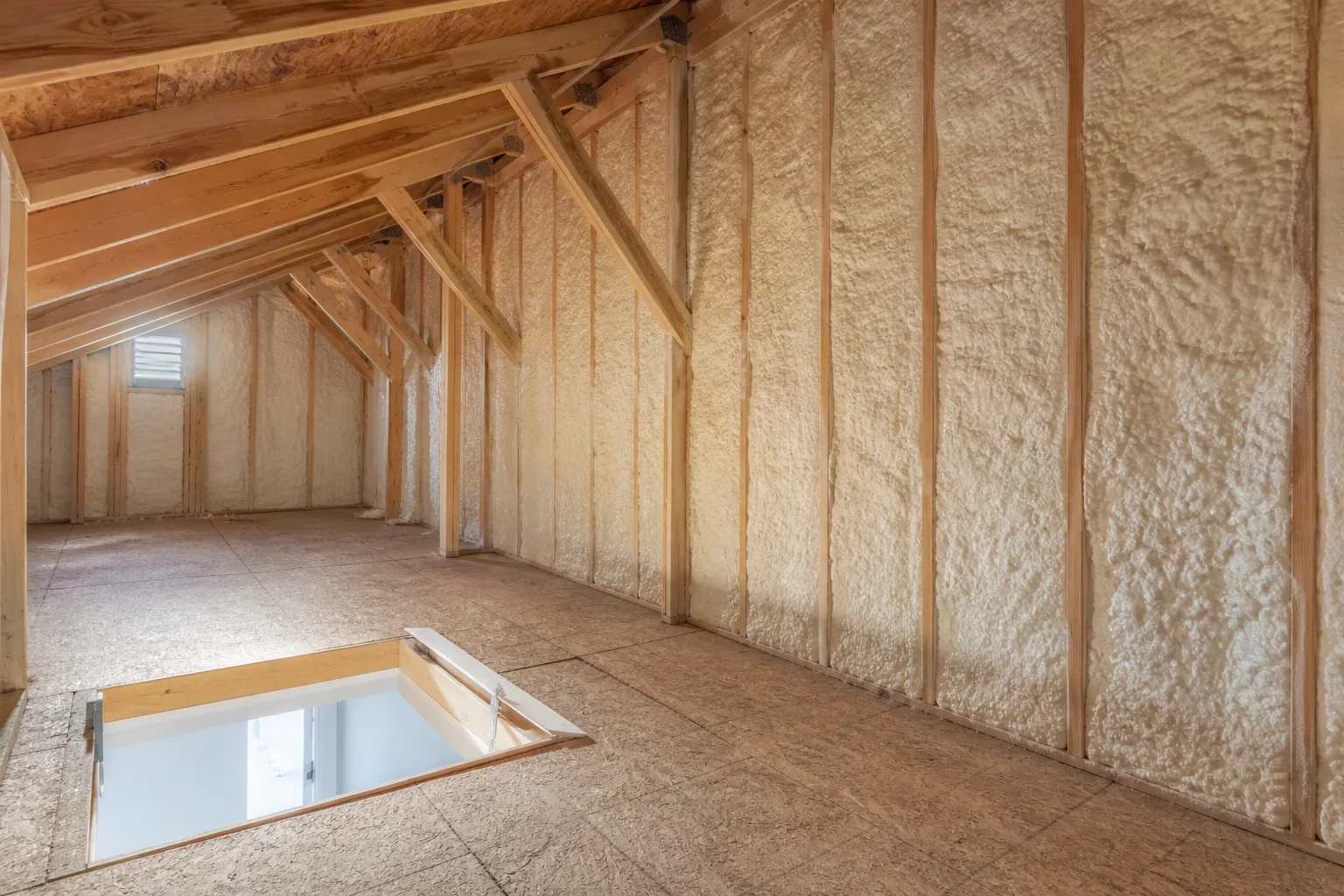
Closed-cell spray foam that looks perfect from underneath a Las Vegas roof deck can still have lost 15 – 25% of its air-barrier continuity at the wood interface after a decade of daily 50°F thermal cycling. You won’t see it as cracks. You see it as a blower-door number that keeps climbing year over year. The repair-or-replace decision usually comes down to whether that loss is happening at the substrate bond or inside the foam cells themselves, and a visual inspection can’t tell you which.
If you’d rather have someone read the evidence with you, call (833) 362-4859. We’re happy to walk through it.
Key Takeaways
- Visible foam is not the same as bonded foam. Adhesion loss at the substrate shows up in numbers, not cracks.
- A rising ACH50 reading on a home with existing spray foam is a diagnostic signal, not a verdict.
- Core-sample adhesion pull-testing is the deciding test for localized repair versus full replacement.
- Las Vegas UV exposure through unsealed ridge vents attacks open-cell foam surface chemistry long before the foam’s R-value falls.
- The break-even between targeted injection repair and full replacement sits in a specific cost-per-R-value range we’ll show below.
Why Does Spray Foam Fail in Las Vegas When It Still Looks Intact?
Spray foam fails at the interface before it fails in the middle. Every time a Las Vegas roof deck heats to 160°F on a July afternoon and drops to 85°F at night, the wood substrate expands and contracts. The foam follows it, flexes, and creeps back. Do that 365 times a year for ten years and you have roughly 3,650 thermal cycles at the bond line. Closed-cell foam handles those cycles better than open-cell, but no foam is immune to what the trade calls glass transition fatigue: repeated movement past the temperature where the polymer goes from glassy to rubbery, which causes microcracking exactly where the foam meets the sheathing.
That’s why the failure never announces itself. Homeowners call us after a summer power bill jumps $80 without explanation, and the foam in the attic looks like it did the day it went in. What changed is adhesion, not appearance. This is the single most common misunderstanding we run into in Las Vegas spray foam homes built or retrofitted between 2010 and 2018.
Open-cell foam adds a second failure mode. Las Vegas sits at roughly 4,500 hours of annual sunshine, and an unsealed ridge vent lets UV light hit the top of the foam deck through gaps in the vented assembly. UV attacks the polyurethane surface chemistry and turns the top skin chalky and friable. From below, it looks fine. From above, it crumbles under a fingernail.
What Does a Rising ACH50 Number Actually Tell You?
ACH50 measures how many times the entire volume of your home’s air exchanges in one hour at 50 pascals of pressure – a blower-door reading. A lower number is tighter. If a Las Vegas home was tested at 3.2 ACH50 the day the foam was installed and now reads 4.8, the envelope has lost measurable continuity. That’s a diagnostic signal. It is not, by itself, proof that the foam needs replacing.
Before anyone opens a cavity, we run a diagnostic sequence:
- Baseline blower-door test. Confirm the current ACH50 with the same equipment and conditions as the original test if the original number exists.
- Pressure-pan the attic plane. Isolate the roof deck from the living space so the leak isn’t coming from a top plate, can light, or chase that has nothing to do with the foam.
- Infrared scan of the roof deck. Look for thermal bridging patterns that indicate debonded panels rather than uniformly thin foam.
- Smoke pencil at known penetrations. Target the plumbing and electrical boots where foam stops short.
- Core-sample adhesion pull-test. Only after steps 1 – 4 point to the foam itself.
Running the sequence in order protects the homeowner from paying for a full replacement when the real leak is a $400 air-sealing job on the attic floor. That order matters more than any single test. When we publish before-and-after blower-door numbers on a job, those numbers reflect all the sealing work, not just the foam.
What Is a Core-Sample Adhesion Pull-Test and When Should You Request One?
A core-sample adhesion pull-test measures the force needed to detach a plug of cured foam from the substrate it was sprayed onto. The technician cuts a small cylindrical sample through the foam down to the wood, attaches a pull fixture, and measures the failure load in pounds per square inch until the bond releases. What it tells you: whether the foam is still chemically bonded to the sheathing or has already begun debonding along the interface.
The threshold we use to recommend replacement versus repair:
- Above 15 psi pull force with cohesive failure (the foam tears internally rather than releasing from the wood): the bond is sound. Localized repair is appropriate.
- Between 8 and 15 psi, or mixed adhesive/cohesive failure: partial debonding. Targeted injection repair in the affected zones is warranted, and a second test one year out.
- Below 8 psi, or adhesive failure across the sample: the interface has failed. Full replacement of the affected deck is the only fix that restores continuity.
Request the test any time you’re told to replace foam based on a visual inspection alone, or when a rising ACH50 number hasn’t got a leak source. It’s a small, localized procedure. It costs a fraction of a replacement and it turns an opinion into a number. In Las Vegas, where thermal cycling is intense and old installations are common, we consider it the deciding test on every foam replacement conversation.
Why Does UV Degrade Open-Cell Foam in Las Vegas and What Coating Actually Protects It?
Open-cell foam depends on a protective coating in any vented assembly, and Las Vegas peak UV is unforgiving. Unsealed ridge vents and gable vents let direct sunlight hit the foam surface through vent gaps, and UV breaks down the polyurethane’s surface chemistry month by month. The foam underneath stays intact; the top 1/8 inch goes chalky and friable. Once that skin is compromised, the surface no longer sheds moisture or resists air movement at the very layer that does most of the barrier work.
A valid coating specification has four parts:
- Product class: a UV-resistant acrylic or elastomeric intumescent coating rated for interior exposure to sunlight through ventilation openings. Ask for the manufacturer’s UV-exposure data sheet, not just the product name.
- Dry-film thickness: typically 20 – 30 dry mils for interior UV exposure. Thinner coats fail early.
- Surface prep: the chalky friable layer must be removed before recoating. Coating over degraded skin just paints the problem.
- Verification: a documented photo record of the coating thickness gauge readings, which we include on every job that involves a recoating scope.
If you see chalky white residue on open-cell foam in a Las Vegas attic, that’s a coating failure, not a foam failure. Recoating is often a repair, not a replacement.
Targeted Injection Repair vs Full Replacement: What’s the Break-Even in Las Vegas?
Here’s the cost-per-R-value math at current Las Vegas labor rates, and it’s the number that decides most of these conversations. Spray foam pricing in Las Vegas runs roughly $1.40 to $2.60 per board foot installed for closed-cell and $0.70 to $1.20 for open-cell, depending on access and roof pitch. Targeted injection repair runs $8 to $15 per square foot of affected deck, including the core sample and post-work blower-door confirmation. Full replacement of a sheathed roof deck runs $4 to $7 per square foot for removal plus installation of new foam.
The break-even:
- If less than roughly 35% of the foam deck shows adhesion failure, targeted injection repair typically costs less than replacing the deck and preserves the sound foam.
- Between 35% and 60%, the math is close. We run a second blower-door confirmation on the repair and let the number decide.
- Above 60%, full replacement is almost always the better spend. You get a documented new installation with a clean blower-door baseline.
R-value itself rarely changes much. What changes is air-barrier continuity, and that’s what the blower door measures. If you’re comparing quotes, our spray foam insulation service page lays out exactly what a written scope should include. We’re also happy to give a free second opinion on any estimate you’ve already received – bring it in and we’ll read it with you, line by line.
When Should You Call a Pro Instead of Deciding Yourself?
Spray foam work involves the roof deck, the air barrier, and sometimes a vertical wall cavity all at once. The diagnostic sequence (blower door, pressure pan, infrared, smoke pencil, pull-test) requires calibrated equipment and, in most cases, a licensed technician to interpret. The adhesion pull-test in particular requires cutting through the cured foam – something you should not attempt on your own, both because the results will be meaningless without a calibrated fixture and because pulling a section of bonded foam from a roof deck can displace adjacent sections that were still working.
Call a professional if any of the following describe your situation:
- Your ACH50 has risen since the original installation and you don’t know why.
- You’ve been quoted a full replacement based only on a visual look at the foam.
- You see chalky or friable foam surface and don’t know if it’s the coating or the foam itself.
- Your home was insulated or retrofitted between 2010 and 2018 and you live in Las Vegas.
Related services in Las Vegas we get asked about alongside foam: attic insulation in Las Vegas, crawl space encapsulation and vapor barrier, and the primary Envelope Insulation Las Vegas home page for our full service line. If your attic has old foam alongside open framing, we can also talk through the trade with you.
One thing worth saying about honesty here: not every foam that looks suspect needs replacing. We pulled core samples on a 2014 build over in Summerlin last month that read 18 psi and cohesive failure – the homeowner was two days from signing a $9,400 full replacement quote. The actual leak was two unsealed can lights. A $640 repair fixed it, and the post-work blower door came in at 2.6 ACH50, better than the original install number. That’s a five-minute test saving a homeowner eight grand, which is the sort of thing the honest foam conversation is about.
What Must a Written Scope for Spray Foam Repair Specify?
A written scope for spray foam repair protects the homeowner by putting three things in writing before anyone opens a cavity: a baseline of the existing foam condition, the measured dimensions of every repair zone, and a post-work blower-door confirmation. Without those three, you can’t tell later whether the job actually worked.
- Existing foam condition baseline. Type of foam (closed-cell versus open-cell), approximate age, thickness, coating status, and the adhesion pull-test results with the exact psi figure and failure mode. This is the “before” the report card gets graded against.
- Repair zone dimensions. Measured square footage per zone, exact locations, and the repair method per zone (injection ports, surface removal, or full panel replacement). “Repair the affected area” is not a scope. “Repair zone 2: 48 square feet above the north soffit between rafters 7 – 10, injection method at 6-inch grid” is a scope.
- Post-work blower-door confirmation. The ACH50 number after the work, measured with the same equipment and conditions, published to the homeowner. Post-work confirmation is what turns a repair into a documented result.
Also write down: the coating specification if recoating is involved (product, dry-film thickness), the warranty terms, and the photo record delivery date. Under our Haven Standard, a written price, written scope, and written warranty are delivered before anyone lifts a tool – no work starts without them. Materials we specify come from Owens Corning, Icynene, Demilec, and GreenFiber, depending on the foam type and the substrate, and we don’t lock a homeowner into a proprietary system.
The Bottom Line
Repair or replace comes down to one question: is the foam still bonded to the substrate? Visible cracks won’t answer that. A blower-door number going the wrong way is the first signal, and a core-sample adhesion pull-test settles it. Above 15 psi with cohesive failure, repair the specific zones. Below 8 psi across the affected deck, replace it. In between, test again in a year and let the numbers guide you. Real evidence beats a visual inspection every time, and any contractor who won’t show you a pull-test result on a full-replacement quote is asking you to trust an evaluation they haven’t done.
If you’re in Las Vegas and want help reading the evidence, Envelope Insulation Las Vegas offers free estimates. We’ll walk through the diagnostic sequence with you, publish the blower-door numbers, and leave you with a documented photo record and written warranty before we leave. Call (833) 362-4859 – a live person answers, 24/7. Background-checked technicians, a written price before any work starts, and a free second opinion on any written estimate you’ve already got in hand. If it’s not done right, the 365-Day Done Right Promise means we make it right. We’ve sealed and insulated over 9,000 homes since 2016 under the same standard, and we’re glad to bring that experience to yours.
Frequently Asked Questions
Targeted injection repair is almost always cheaper when less than roughly 35% of the foam deck shows adhesion failure – repair runs $8 to $15 per square foot of affected area versus $4 to $7 per square foot for full deck replacement once you’re above 60% failure. Between those points, the break-even depends on the post-repair blower-door result. Call (833) 362-4859 and we’ll get a written price in front of you before any work starts.
Yes, in most cases. Injection repair accesses the failed zone through small ports drilled from below or above, fills the debonded area with new foam, and reseals the ports. A core-sample pull-test confirms whether injection is appropriate. Call (833) 362-4859 for a free estimate – we’ll confirm the diagnosis before we recommend a method.
Look for three signals: a rising ACH50 reading on a blower-door test, chalky or friable surface on open-cell foam near ridge vents, and a jump in summer power bills without any other cause. Visible cracks are rarely the first sign. Call (833) 362-4859 for an assessment and we’ll bring the equipment that turns signals into numbers.
Yes for open-cell foam exposed to sunlight through unsealed ridge or gable vents. UV breaks down the polyurethane surface chemistry and turns the top skin friable. A UV-resistant coating at 20 – 30 dry mils, applied to properly prepped foam, is the standard fix. If you’ve got open-cell foam in a vented Las Vegas roof deck, call (833) 362-4859 for a coating assessment.
Written by the team at Envelope Insulation Las Vegas.
Need Insulation Help?
Call Envelope Insulation Las Vegas - licensed & insured, here with fast after-hours help in Las Vegas.
(833) 362-4859