Rockwool Attic Insulation in Las Vegas: A Homeowner’s Guide
Rockwool attic insulation in Las Vegas works well when it’s installed over a sealed attic floor and sized for the heat. The catch most guides skip: mineral wool’s R-value is tested at 75°F, and a Vegas attic spends July afternoons well past 130°F. That gap between the label and the attic is the whole story. Below is what the numbers actually say for a 1,500 sq ft Las Vegas home. If you’d rather not sort it out alone, call (833) 362-4859.
Here’s what we’ve learned the hard way. A Las Vegas attic in July holds enough radiant heat to stay above 130°F at midnight. Rockwool’s rated R-value is tested at 75°F, not 130°F, and thermal performance drifts as temperatures climb. Most product guides leave that part out. We’ve opened attics in Summerlin and Spring Valley where the wool looked fine and still underperformed because nobody sealed the floor first.
Key Takeaways
- Rockwool (mineral wool) is fire-resistant, sound-dampening, and moisture-tolerant, but its tested R-value assumes a 75°F lab, not a desert attic.
- Rigid batts leave gaps at truss intersections more easily than blown products. Those gaps have to be measured with a blower door, not eyeballed.
- For a 1,500 sq ft attic floor, installed Rockwool generally runs higher per R-unit than blown fiberglass and lower than open-cell spray foam.
- Fire performance is real: mineral wool is non-combustible with a smoke-developed index of 0 and a flame-spread of 0 in standard ASTM E84 testing. That satisfies Nevada residential code, but code compliance isn’t the same as a comfortable attic.
- A finished job should come with before-and-after blower-door numbers and photos, not a verbal “looks good.”
Does Rockwool’s R-Value Hold Up in a Las Vegas Attic?
Not at the temperature your attic actually reaches. R-value measures resistance to heat flow at a standard test condition, usually a mean temperature near 75°F. In a Las Vegas attic in August, the surface the insulation sits against and the air above it can run 130°F to 160°F. Mineral wool holds its structure at those temperatures better than many materials, but its effective R drops as the temperature difference across it grows. The packaging number is a starting point, not the field number.
That matters because insulation is sized to a target, and most Las Vegas homes want R-38 to R-49 in the attic for our climate zone. If you buy Rockwool to hit R-49 using the label value and the attic runs hot, you’ve under-built by the time the July sun is done. We size mineral wool a little thicker here than a cool-climate chart would suggest, and we say so on the written scope. The other half of the equation is air sealing, which no R-value can fix. When we’ve pulled damp, sagging batts out of a home in the northwest part of the valley, the problem was almost always unsealed penetrations feeding hot, humid air into the assembly, not the wool itself.
Why Air Sealing Has to Come Before Rockwool Batts
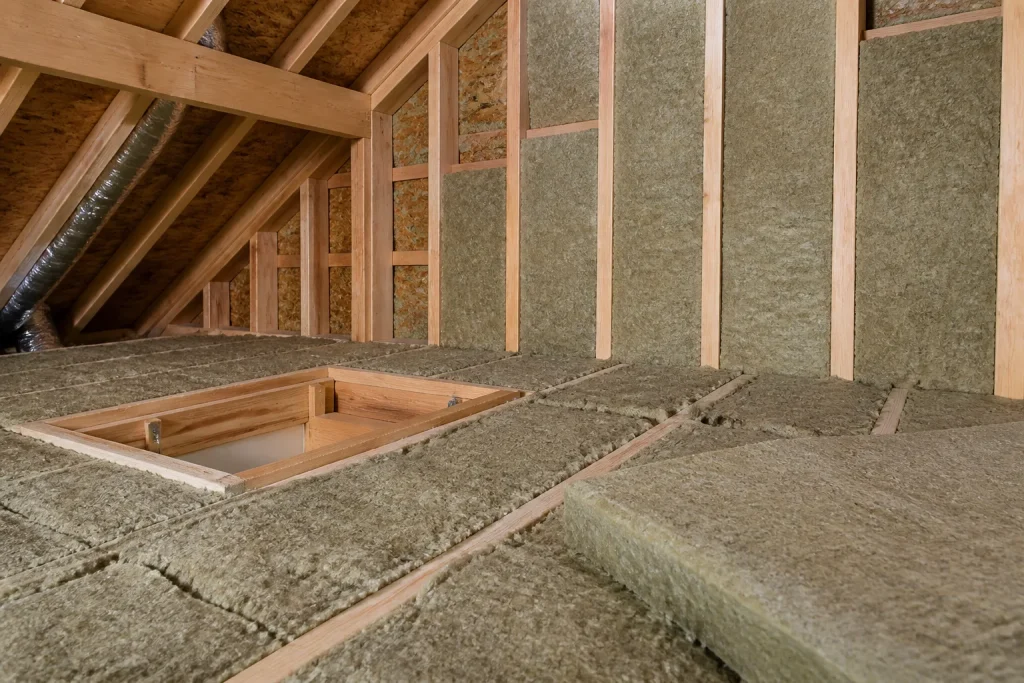
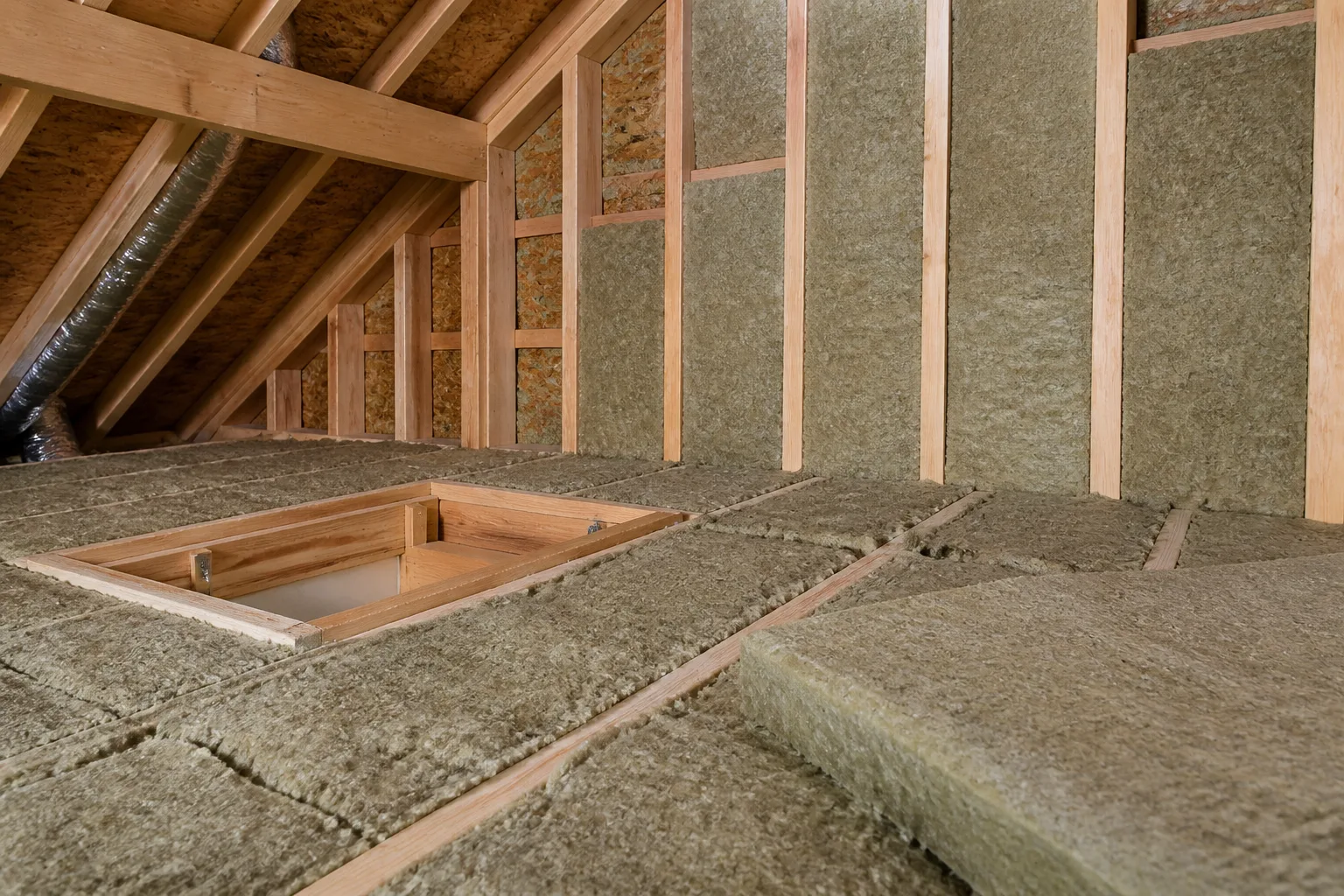
Because Rockwool batts are rigid, and rigid batts bridge differently than blown insulation. Mineral wool comes as semi-rigid slabs pressed into the joist bays. Around truss webs, wiring, can lights, and top plates, the slab either gets cut to fit or it leaves a gap. On a Las Vegas attic floor, a gap of a quarter inch at every truss intersection adds up across hundreds of bays. Those gaps leak conditioned air straight into the attic, and the wool sits on top doing nothing about it.
We never blow or lay insulation over an unsealed attic floor, and that rule matters more with Rockwool than with loose fill. The order is fixed:
- Air seal first. Top plates, can lights, plumbing and wiring penetrations, and the attic hatch get sealed with caulk, foam, and rigid covers.
- Then measure. A blower-door test, which pressurizes the house and reads the total air leaking through the envelope in CFM50 (cubic feet per minute at 50 pascals), gives us a number before insulation goes down.
- Then install the Rockwool. Batts get cut tight and butted, not laid loose over gaps.
- Then measure again. The second blower-door reading shows what the sealing actually bought, in one figure.
If a contractor wants to lay batts without sealing first, that isn’t a shortcut. It’s a different, worse job. For the sealing side of the work, see our page on attic insulation in Las Vegas, which covers the sequencing in detail.
What Does Rockwool Attic Insulation Cost in Las Vegas?
For a typical 1,500 sq ft attic floor, installed Rockwool generally runs in the range of $2.50 to $4.00 per square foot, before air sealing is added. That’s a field comparison, not a lab number, and it moves with R-value target and attic access. Here’s how the three common options stack up for a 1,500 sq ft Las Vegas attic floor using 2026 material costs:
| Option | Installed cost (1,500 sq ft) | Approx. cost per R-unit | Notes for a Vegas attic |
|---|---|---|---|
| Blown fiberglass | $1,300 – $2,200 | Lowest | Cheapest per R; needs careful depth marking, settles over time |
| Rockwool batts | $2,500 – $4,200 | Middle | Fire and sound benefits; rigid gap risk requires sealing and verification |
| Open-cell spray foam | $3,800 – $6,000 | Highest | Seals and insulates in one step; premium price |
The comparison that actually matters isn’t dollars per square foot. It’s dollars per R-unit delivered in a hot attic, plus the cost of the air sealing that makes any of these options work. A homeowner in Henderson comparing three quotes for the same attic will usually see the cheapest number land on blown fiberglass, and the widest spread on spray foam. Rockwool sits in the middle, and it earns that middle spot on fire performance and noise, not on R-per-dollar. For the spray-foam side, our spray foam insulation in Las Vegas page breaks down where it pays off.
Fire Ratings and Smoke Numbers You Should Actually Know
Rockwool is genuinely non-combustible, and the numbers back it up. In standard ASTM E84 surface-burning tests, mineral wool typically reports a flame-spread index of 0 and a smoke-developed index of 0. Those are the real figures, not marketing language, and they’re part of why mineral wool is used as a firestop around penetrations and in fire-rated assemblies. For a Las Vegas home, that fire behavior is a legitimate reason to consider it, especially near attached garages and mechanical chases.
But fire compliance and attic comfort are two different jobs. Nevada residential code looks at flame spread and smoke development for the materials, and Rockwool passes those checks comfortably. What code doesn’t do is keep your attic at 75°F. We’ve seen fiberglass labeled “fire-rated” fail in a home in the south part of the valley, not because of fire, but because it was jammed against a hot surface without clearance. Any insulation, including Rockwool, has to respect the clearance around recessed lighting and flues. We spell that out on the written scope: what gets IC-rated covers, what gets an air gap, and what stays untouched. Under Haven Standard Clause 1, you get a flat price, a written scope, and a written warranty before anyone lifts a tool.
What Should the Blower-Door Reading Look Like After a Rockwool Job?
The second reading should be meaningfully lower than the first, and the number should travel with the finished job. A blower-door test measures how much air the whole house leaks, in CFM50. Before air sealing, an older Las Vegas attic floor often reads high. After proper sealing of top plates and penetrations, then a tight Rockwool installation, that figure should drop, and the drop is what you paid for. There isn’t one “correct” number for every house, because square footage, window quality, and construction type vary. What matters is the before-and-after pair, measured on the same house, by the same test.
When a Rockwool attic job is done right in Las Vegas, you should leave with:
- The before-and-after blower-door readings, written down.
- A documented photo record of the sealing work and the finished batt layout.
- The written scope that says which penetrations were sealed and the R-value achieved.
- The written warranty and the 365-Day Done Right Promise behind it.
If a contractor can’t tell you what the CFM50 number was before they started, ask why. Our technicians have up to 10 years of experience running these tests, and background-checked, uniformed techs answer calls around the clock because we know this stuff can’t wait for business hours. If your attic also has moisture issues or you’re seeing condensation, our crawl space encapsulation and vapor barrier in Las Vegas page covers the related side of the envelope. And for the full picture of what we do, start at the Envelope Insulation Las Vegas home page.
When to Call a Pro
DIY Rockwool is possible for a small, well-sealed attic. A 1,500 sq ft Las Vegas attic floor in July is not that job. The heat alone is a real hazard, and rigid batts need precise cutting and a blower door to verify sealing. If you’re planning to size mineral wool against a 130°F-plus attic, seal dozens of penetrations, and confirm the result with a measurement, that’s a pro job. If a competitor’s quote just says “blow in insulation,” ask what their blower-door number is. As a free second opinion, we’ll read a competing written estimate with you, line by line.
Related services in Las Vegas: if Rockwool isn’t the right fit for your attic, we also install blown fiberglass from Johns Manville and Knauf and open-cell foam, so we can compare on your specific house.
The Bottom Line
Rockwool attic insulation in Las Vegas is a sound choice when it’s sized for the heat and installed over a properly sealed floor. The fire performance is real, the noise damping is real, and the moisture tolerance is real. What the packaging doesn’t tell you is that a 75°F test number and a 130°F attic are two different worlds, and that rigid batts punish sloppy sealing more than blown products do. Seal first, size for the heat, and demand the before-and-after blower-door number. If you’re in Las Vegas and need help, Envelope Insulation Las Vegas offers free estimates, a written price before work starts, and documented photos on every visit. Call (833) 362-4859.
Frequently Asked Questions
Is Rockwool good for a Las Vegas attic? Yes, with two conditions: it has to be sized for attic temperatures well above its 75°F test rating, and the attic floor has to be air sealed before the batts go down. Rockwool’s fire resistance and sound damping are genuine advantages, but its R-per-inch is measured in a lab, not at 130°F.
Is Rockwool better than blown fiberglass in desert heat? Not on cost per R-unit. Blown fiberglass is cheaper to reach the same target R-value. Rockwool wins on fire performance and noise, and stays put better around obstacles, but it costs more per R. We compare both on a house-by-house basis and put it in writing.
Can I install Rockwool batts myself in Las Vegas? You can, but a 130°F-plus attic is dangerous and rigid batts need precise cutting around trusses and penetrations. If you’re not going to run a blower-door test before and after, you won’t know whether the sealing worked. That’s the part most DIY jobs skip. Call (833) 362-4859 for a free estimate and a look at what a verified job includes.
What smoke and flame numbers does Rockwool actually have? Mineral wool typically reports a flame-spread index of 0 and a smoke-developed index of 0 in standard ASTM E84 testing. Those are the real figures, and they’re why it’s used as a firestop. Nevada residential code cares about those numbers, but they don’t affect how hot your attic gets. Call (833) 362-4859 to talk through sizing.
Call (833) 362-4859 for a free estimate in Las Vegas.
Written by the team at Envelope Insulation Las Vegas.
Need Insulation Help?
Call Envelope Insulation Las Vegas - licensed & insured, here with fast after-hours help in Las Vegas.
(833) 362-4859