Owens Corning Attic Insulation in Las Vegas: A Homeowner’s Guide
Roughly 60% of Las Vegas homes built between 1995 and 2010 have Owens Corning blown fiberglass in their attics installed at R-19 or less. That was code-minimum then. It sits roughly 40% below what Nevada’s current energy code asks for in this climate zone. So the real question for most Las Vegas homeowners isn’t which brand to buy. It’s whether the Owens Corning insulation already overhead was installed to the density and coverage the original installer was supposed to document – and whether anyone can prove it.
If you’d rather have someone read your attic than climb into it yourself, call (833) 362-4859. The estimate is free, and no work starts without a written price in hand.
This guide walks through the four things that actually determine whether your existing fiberglass is performing: wind-washing at the eave vents, compressed or dirty batts, the density difference between product lines, and the paper trail the coverage chart is supposed to leave behind.
Why Does Most Owens Corning Attic Insulation in Las Vegas Disappoint?
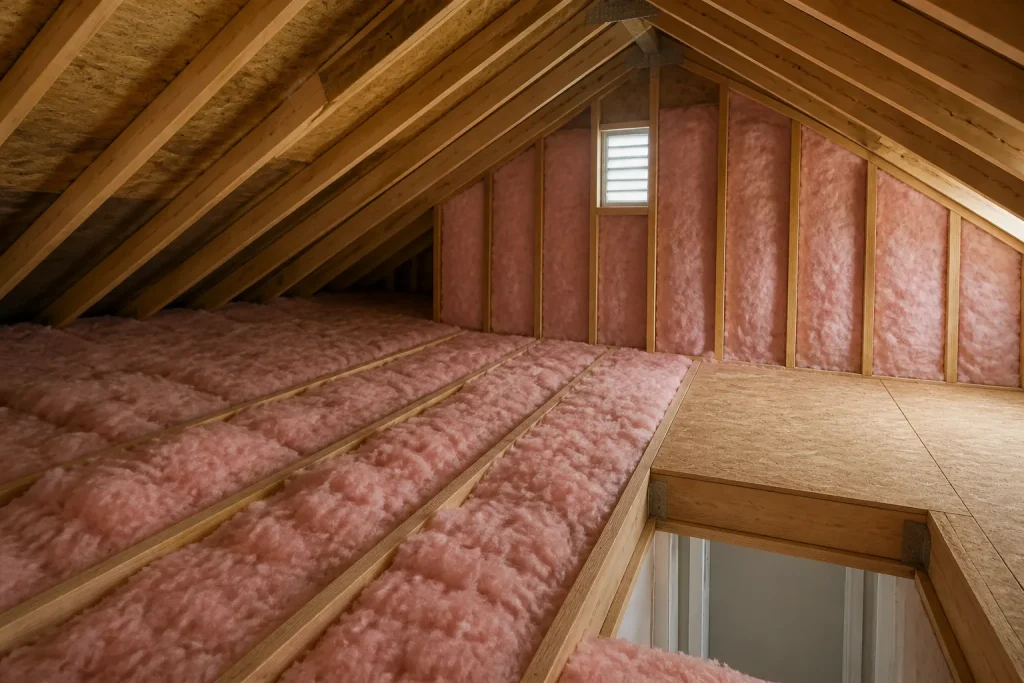
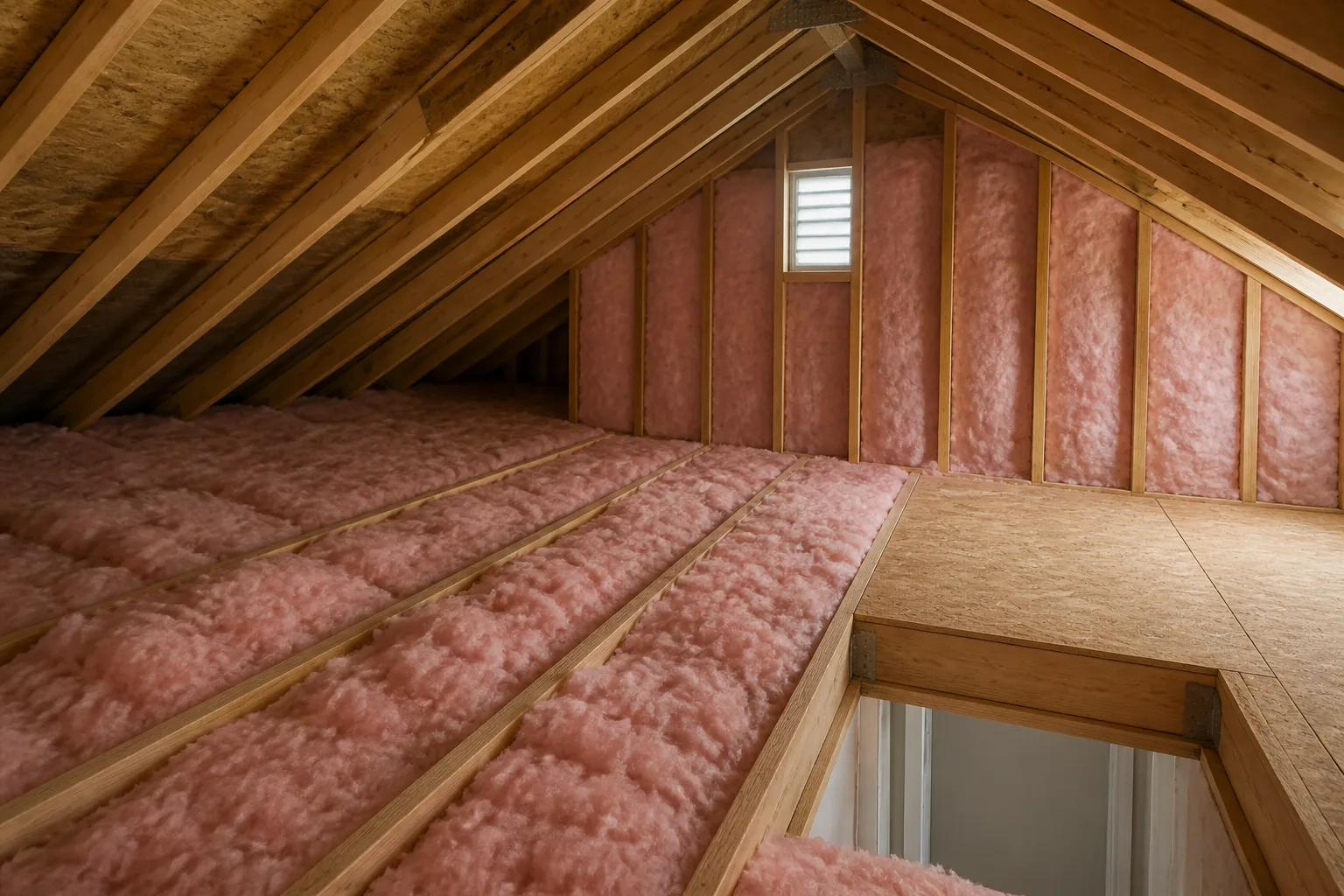
Because the material is fine and the installation usually isn’t. Owens Corning fiberglass is the most commonly specified attic insulation in Las Vegas new construction, which is why so many upgrade calls we get start with a homeowner pointing at pink fiberglass and asking whether the brand was the problem. It almost never is. The problem is that fiberglass only insulates at its rated R-value when it’s installed at the right depth, at the right density, with the air leaks below it sealed first.
When those conditions aren’t met, you get an attic that looks insulated and doesn’t behave insulated. The house holds heat through July and August, the upstairs bedrooms run five to eight degrees warmer than the thermostat setting, and the utility bill tells you something’s wrong without telling you what.
A few things we find again and again in Las Vegas attics:
- Depth measured at the wrong spot. A ruler stuck in near the access hatch often reads R-38. The same ruler out at the eaves frequently reads R-19 or less, because installers blow toward the center and thin out at the perimeter.
- No air sealing underneath. Top plates, can lights, plumbing penetrations and the furnace flue chase all leak conditioned air straight into the attic. Insulation laid over them doesn’t stop the leak. It just hides it.
- Wind-washing at the eave vents. This one is the biggest hidden loss and almost nobody checks for it. More on that below.
- Compressed fiberglass under plywood catwalks or storage decks. R-38 compressed to four inches is no longer R-38.
If your home is among the many Las Vegas houses running on an undersized original spec, the fix starts with attic insulation in Las Vegas done right – air sealing first, then a documented top-up to current code.
What Is Wind-Washing, and Why Does It Steal R-Value in Las Vegas Attics?
Wind-washing is air movement through the outer edge of the insulation blanket where it meets the eave vents. If the fiberglass was blown right up against the vents with no baffle, or if it was installed too thin at the perimeter, outside air scours through the material every time a breeze moves across the roof. That airflow strips heat from the insulation itself. The rated R-value assumes still air inside the fiberglass. Moving air turns fiberglass into a filter.
You can spot it without a blower door. Get a flashlight and look at the insulation where the roof slope meets the top plate at the eaves:
- Wavy or rippled surface texture near the vents – that washboard pattern is airflow physically disturbing the fibers.
- Visible dark streaks or staining in the fiberglass, which is filtered dust telling you air has been moving through it.
- Daylight visible between the insulation and the baffle, or no baffle at all.
- Thin coverage – under R-19 in the last two feet before the vents is common and cuts effective performance well below the rated number.
In our experience a Las Vegas attic with heavy wind-washing at the eaves can lose 15% to 25% of its effective R-value along the perimeter. That’s the hottest part of the ceiling plane in a Las Vegas summer. Fixing it means installing proper baffles and blowing back to depth at the eaves – not just adding more material over the top of a compromised edge.
AttiCat vs. ProPink L77: Which Owens Corning Product Fits Las Vegas?
Both are blown fiberglass. They’re not interchangeable, and the difference matters in this climate. Owens Corning AttiCat is a loose-fill fiberglass designed for its coverage – it goes in fast and reaches target depth with less material by volume. ProPink L77 is a higher-density loose-fill fiberglass, and density is what keeps the material from settling and from losing R-value to air movement over time.
For Las Vegas conditions – long cooling seasons, attics that hit 140°F and above, and wind-driven dust off the desert – we generally specify L77 where the goal is a durable top-up over existing fiberglass, and where the attic has any history of wind-washing or settling. The higher density holds its installed thickness better through thermal cycling. AttiCat gets used where the deck is open, well-sealed, and coverage math is straightforward.
What you should ask any contractor quoting you Owens Corning material:
- Which product is going in, AttiCat or L77, and why that one for your attic?
- What target depth in inches, and what settled R-value at that depth?
- Will the installer leave the Owens Corning coverage chart on-site?
That last question is the quiet test of whether the job will be documented. If the answer is vague, the paperwork will be too.
What Should the Owens Corning Coverage Chart Prove – and Where Does It Belong?
The Owens Corning coverage chart is a printed document that shows, for a specific product and a specific bag count, what depth was installed and what R-value that depth delivers. Every blown-in job has one. Most homeowners never see it.
It belongs in your house file, and here’s why. The chart is the only record tying the bags of material that went into your attic to the R-value you were promised. If a later energy audit or a home sale inspection finds R-30 where you were sold R-49, the chart is how you prove the gap. It’s also how a future contractor knows what they’re adding to – topping up over existing material without knowing the depth and density underneath is guesswork.
At Envelope Insulation Co., the coverage chart goes in the same packet as the written scope, the written warranty and the photo record of the attic floor before and after. Under the Haven Standard – our operating standard, in place since 2016 – a homeowner should be able to hand that folder to anyone and have the whole job explained in writing. That’s the point.
If you get a quote from another Las Vegas contractor and there’s no coverage chart listed in the scope, that’s not a reason to panic. It’s a reason to ask. And if you’d like a second read on the estimate, we do a free second opinion on any written quote – bring it in and we’ll read it with you.
Does Adding Insulation Over Existing Fiberglass Actually Help?
Only if the air sealing gets done first. This is the part most attic insulation conversations skip, and it’s the reason a top-up sometimes disappoints the homeowner who paid for it.
Here’s the mechanism. Insulation slows conductive heat transfer. It does nothing about air moving through holes. When top plates, recessed can lights, plumbing chases and the flue penetration leak conditioned air into the attic, that air leaves the house regardless of how thick the fiberglass is. Blowing R-25 of new material on top of an unsealed attic floor gives you a taller blanket over the same holes. The house still leaks.
Rough numbers from the Las Vegas homes we see in the 1995 to 2010 build range: a typical attic without air sealing runs 3,500 to 5,500 CFM50 on the blower door – the pressurization test that measures, in one figure, how much air the building envelope loses. After air sealing the same attic, before any new insulation, those numbers commonly drop 25% to 40%. The insulation goes in second, and it holds what the sealing bought.
So the sequence for a Las Vegas top-up should always read: seal the bypasses, verify the leakage reduction, then add depth. Reverse it and you’ve paid for material that can’t do its job. Our rule under Haven Standard Clause 1 is simple – flat written price, written scope, written warranty before anyone lifts a tool. That scope should say “air sealing” by name. If it doesn’t, ask why.
Where the attic has more going on – a soffit detail no one sealed, a vaulted section that needs foam rather than fiberglass – the answer may be spray foam insulation in Las Vegas for that portion, with the flat attic topped up in fiberglass.
How a Blower-Door Test Proves the Job Was Done
The blower door is a calibrated fan that mounts in an exterior door frame and pressurizes the house to a set pressure, then measures how much air has to move to hold that pressure. The result, in CFM50, is a single number for the whole building envelope. It’s the same test every time, so the before-and-after readings are directly comparable.
What we publish on applicable jobs is the pair: the CFM50 reading before any work started, and the reading after air sealing and insulation were completed. That figure tells a homeowner what they actually bought. “The attic read 4,600 CFM50 before we sealed it and 2,700 after” is a claim you can verify. “We greatly improved your home’s efficiency” is not. The number is the record. It’s also why the photo record – the can lights before sealing, the top plates after, the depth ruler at the far eave – travels with it.
The 365-Day Done Right Promise backs all of this with a written scope and written warranty in hand before work starts. If it isn’t done right, we make it right.
When to call a pro
Fiberglass itself is manageable. The two things that are not a DIY job in a Las Vegas attic are the ones with real risk:
- Electrical at the ceiling plane. Air-sealing around recessed can lights and wiring penetrations means working at live electrical fixtures in a hot, confined space. This is a licensed trade for a reason, not a homeowner project.
- Combustion appliances. Sealing the furnace flue chase or anything near a gas appliance without knowing the draft and venting requirements can create a carbon monoxide hazard. A trained professional should handle it, and the sealing should be plotted against the combustion appliance specs, not guessed at.
If your attic has either condition, the safe answer is to have it evaluated by someone who does this every day. Our technicians have up to 10 years of experience, and they’re background-checked and uniformed, with a text when they’re on the way (Haven Standard: arrive on schedule).
Related services in Las Vegas: for an attic with moisture or duct issues, see crawl space encapsulation & vapor barrier in Las Vegas and the full Envelope Insulation Las Vegas home lineup for energy audits and attic cleaning.
The Bottom Line
Owens Corning fiberglass is a sound choice for a Las Vegas attic – it’s the material most of these homes already have. The question isn’t the brand. It’s whether your existing installation meets its rated depth, whether it’s been wind-washed to worthlessness at the eaves, and whether the air sealing underneath it was ever done. Answer those three and you’ll know if you need a top-up, a repair at the perimeter, or nothing at all. Ask for the coverage chart and the blower-door numbers. If a contractor can’t produce them, keep looking.
If you’re in Las Vegas and want that read done right, Envelope Insulation Co. offers free estimates – call (833) 362-4859. A live person answers, day or night, and every job starts with a written price before any work begins.
Frequently Asked Questions
Yes. Owens Corning fiberglass handles Las Vegas heat well when it’s installed at the right depth and density and the air leaks beneath it are sealed. For most attics here we specify ProPink L77 for a durable top-up over existing fiberglass, or AttiCat where the deck is clean and well-sealed. The performance is in the installation, not the label. Call (833) 362-4859 for a free read on what your attic actually needs.
Measure depth at the far eaves, not the center, and look for wavy fiberglass or dark streaks near the vents – the visual signs of wind-washing. Then check whether the attic floor was air-sealed before the insulation went in. If you can’t answer that, a blower-door test settles it in one figure. A free estimate from Envelope Insulation gives you a written scope and a documented photo record, so call (833) 362-4859.
Topping up is almost always cheaper when the existing fiberglass is clean and dry – you’re paying to add depth, not to remove and reinstall. Replacement makes sense if the material is contaminated with rodent waste, saturated, or compressed below useful depth under decking. In Las Vegas, contamination from rodent activity is the most common reason we recommend removal first. Call (833) 362-4859 and we’ll tell you which one your attic calls for before any work starts.
Nevada’s current energy code for this climate zone calls for roughly R-49 in the attic, which is comfortably above the R-19 or less that many Las Vegas homes built from 1995 to 2010 were delivered with. Depth needed for R-49 varies by product – AttiCat and L77 don’t hit the same R-value at the same inches, which is exactly why the Owens Corning coverage chart should be left on-site. Call (833) 362-4859 for a free estimate with the target depth and R-value in writing.
Written by the team at Envelope Insulation Co.
Need Insulation Help?
Call Envelope Insulation Las Vegas - licensed & insured, here with fast after-hours help in Las Vegas.
(833) 362-4859