
Johns Manville Attic Insulation in Las Vegas: A Homeowner’s Guide
Johns Manville’s Climate Pro blown fiberglass needs a minimum installed density of 1.8 lb/ft³ to hit its rated R-value, and that threshold only holds if the crew runs calibrated equipment and documents a bag count per 1,000 square feet. Most residential bids around Las Vegas don’t itemize either one. If you’re comparing quotes and one of them names Johns Manville without naming density or bag counts, you’re looking at a number that may not survive the first summer. If you’d rather not sort through that yourself, call (833) 362-4859 and we’ll walk you through a quote line by line.
Why Johns Manville Shows Up in Commercial Work but Rarely in Residential Bids
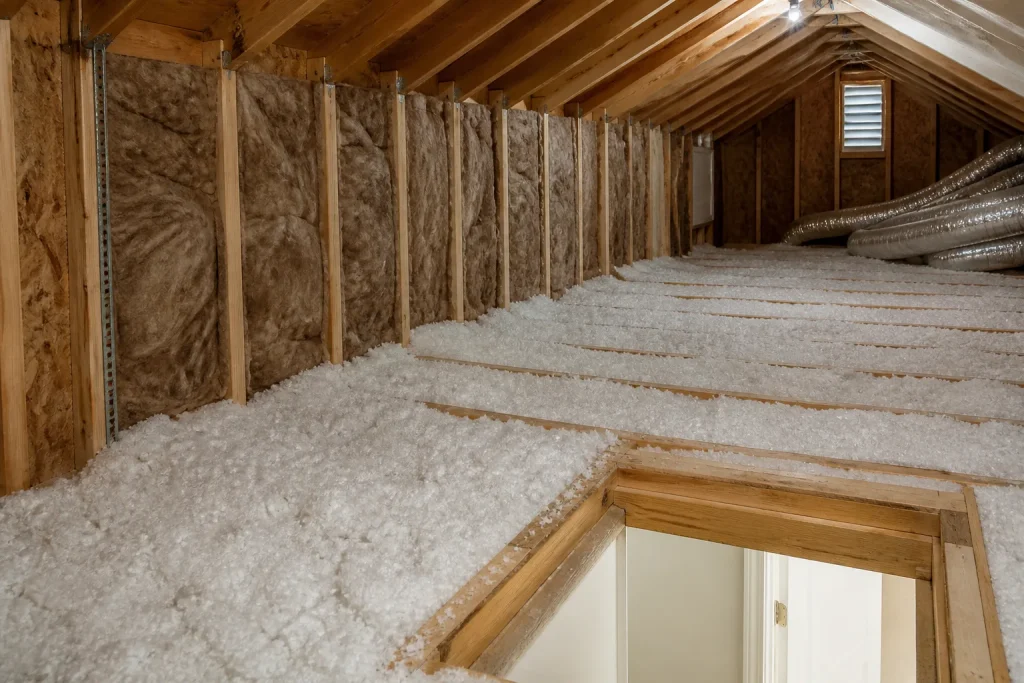
Drive past any mid-rise going up near the Strip or a new apartment block in Summerlin and there’s a decent chance Johns Manville products are in the specification. The brand is written into commercial and multi-family work constantly. Residential is different. In Las Vegas, we see far fewer JM bids on single-family attics, and it’s not a knock on the product. It comes down to training.
JM’s blown fiberglass has tight density tolerances. A crew that’s used to blowing loose fill by feel, without a scale or a bag count, can install JM fiberglass at the wrong density and never notice. The R-value on the bag is the R-value at spec density. Install it lighter and you’ve paid for R-49 and received something closer to R-38. In a mild climate, that gap might cost you a little on the bill. In Las Vegas, where attic temperatures push past 150°F on a July afternoon, that gap shows up as rooms that won’t cool and a compressor that runs all evening.
What we’ve found in our own work: the product is fine. The install discipline is the variable. That’s the whole argument for asking more questions before you sign.
What Density Actually Means, and How You Verify It After the Job
Density is weight per volume. For JM Climate Pro, the target is 1.8 lb/ft³. You can’t measure that with a tape measure, and you shouldn’t try to eyeball it. What you can do is check the paperwork, because density is a math problem once the job is done.
Every bag of JM blown fiberglass carries a coverage chart. The chart tells you how many bags are needed per 1,000 square feet at a given R-value and density. The verification works like this:
- Get the attic’s square footage. Not the house’s footprint. The actual attic floor area, minus any HVAC platforms or chases.
- Look up the required bag count on the JM coverage chart for the R-value you paid for.
- Compare that to the bags the crew actually installed. If the invoice says 22 bags and the chart calls for 30, you got less than you paid for.
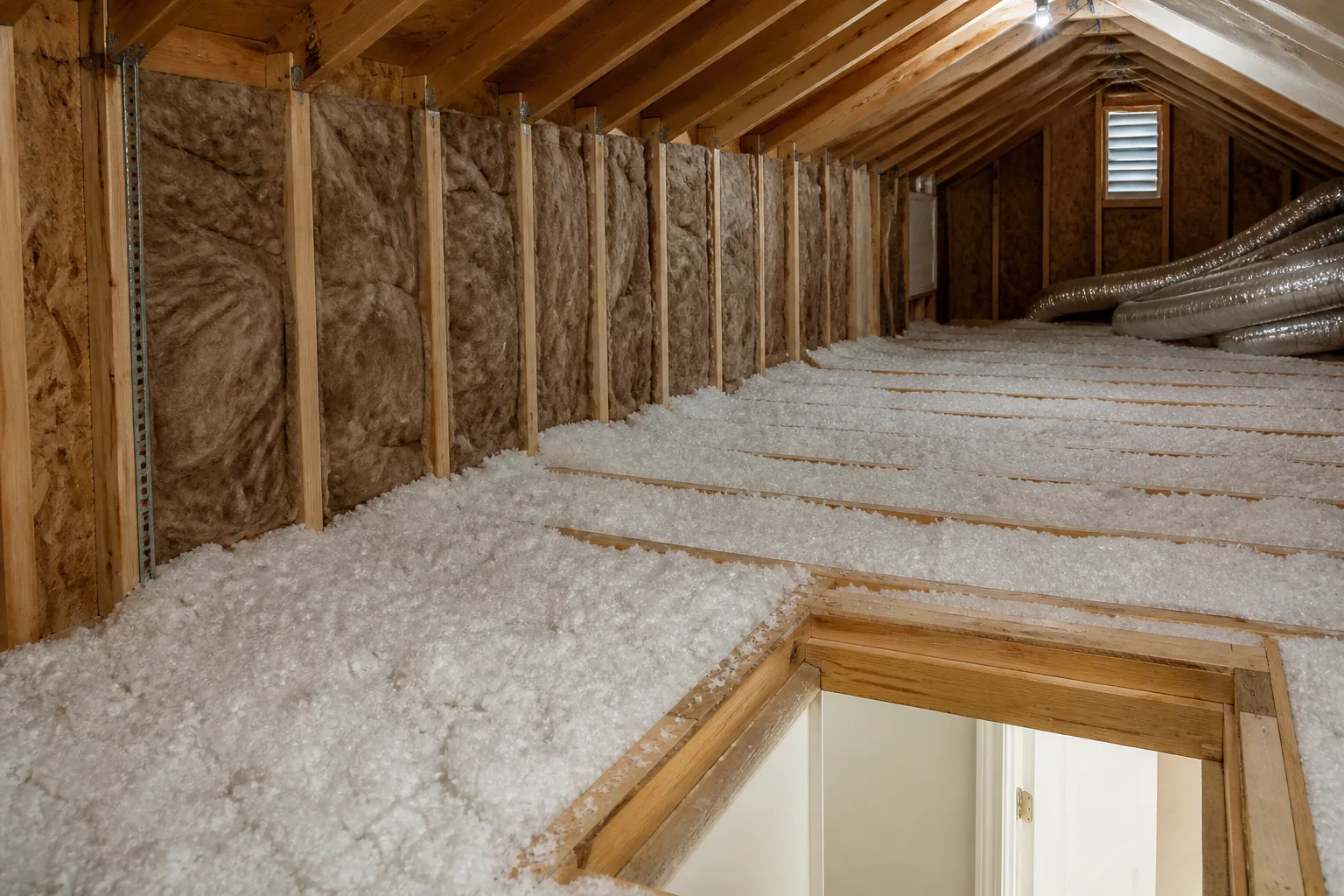
- Document the depth. A ruler photo at three or four points across the attic shows the settled depth. It doesn’t prove density, but it catches the obvious under-blows.
We’ve pulled bag counts from jobs in Henderson where the crew installed 60% of the fiberglass the coverage chart called for and the homeowner had no way to know until their August bill arrived. The bag count is the single most useful number on the invoice, and it’s the one most homeowners never look at.
If you’re still mapping out the right product for your home, our page on Attic Insulation in Las Vegas covers how R-value targets shift with our climate zone.
Fire Ratings and Why They Matter More in Las Vegas Construction
Johns Manville fiberglass carries non-combustible ratings and is often specified in commercial assemblies partly for that reason. In high-performance residential builds around Las Vegas, the same documentation is starting to get pulled into spec sheets, especially on homes with foam-plastic components in the wall assembly or attached garages that share an attic plane with the house.
What you want from a contractor on a JM job:
- The product data sheet for the specific JM product installed, not the brand website’s general page.
- The fire-rating documentation that applies to the assembly, if your build has one on the plans. Ask for it in writing.
- Material receipts showing the actual product and quantity delivered to your address.
Rockwool and Knauf both make non-combustible products in the same category, so if a bid specifies one of those instead of JM, the conversation shifts to density and coverage charts rather than fire performance. The documentation question stays the same.
Wind-Washing, Soffit Vents, and JM’s Fiber Length
Las Vegas attics vent hard. Soffit vents, ridge vents, and the occasional gable vent all work together to move air through the attic, and that movement is the point. The problem is when it moves through the insulation instead of over it. That’s wind-washing: air passing through the fiberglass, stripping heat from the surface and dropping the effective R-value right where the insulation meets the vent.
JM’s blown fiberglass has a fiber length distribution that resists this better than some short-fiber products, especially when it’s at proper density. At low density, the fibers are loose, air moves through them more easily, and the wind-washing problem gets worse. This is one of the reasons we care so much about density in Las Vegas specifically: our ventilated attic designs and the temperature differentials they create punish sloppy installs harder than milder climates do.
The fix is mechanical: baffles installed at the soffit vents to keep the insulation out of the air path, and enough depth at the perimeter to hold up against the airflow. Both should be visible in the photos the crew takes before they leave.
Air Sealing Before You Blow Johns Manville: Which Bypasses Matter
This is the part most bids skip. Blown fiberglass, including JM, is not an air barrier. It’s a thermal barrier. If conditioned air is escaping through a hole in your attic floor, the insulation slows the heat transfer but doesn’t stop the air. Worse, air movement through the fiberglass can migrate the material and disturb the density over time. The insulation settles, thins at the bypass, and the R-value you paid for starts to slip.
Before any fiberglass goes in, the following need to be sealed with foam or caulk:
- Top plates where the wall framing meets the attic floor, especially at exterior walls.
- Can lights rated for insulation contact (IC-rated), or you need a box built over them. Sealing around non-IC cans is a fire risk and should never be done.
- Plumbing and electrical penetrations, including the gap around every wire and pipe that passes through the ceiling plane.
- Chases, duct boots, and bath fan housings, which are frequently the biggest leaks in a Las Vegas attic.
- Attic access hatches and knee walls, if the attic shares a plane with a sloped ceiling.
We won’t blow insulation over an unsealed attic floor. It’s not an upsell, it’s the sequence. If a crew is willing to skip the sealing to keep the bid low, your bag count won’t save you. The material will settle at the leaks and you’ll be back at the same problem in two summers.
What a Completed JM Job Should Look Like on Paper
When the crew leaves, you should be holding a specific set of documents. Not a glossy folder. A record. Here’s what we consider the minimum on any JM blown-in job:
- Coverage chart for the actual JM product installed, with the R-value and density you paid for circled.
- Bag count recorded on the invoice, matched against the chart for your square footage.
- Depth ruler photos at multiple points across the attic, showing settled depth against a labeled ruler.
- Air-sealing photo record showing the sealed top plates, can lights, and penetrations before the fiberglass went in.
- Before-and-after blower-door readings if air sealing was part of the job. A blower-door test is a pressurization reading that shows, in one number, how much air your building envelope was losing before and after the work.
That last item is where most bids go quiet. A blower-door number is the only figure on the job that shows what the whole system accomplished, not just the material deliverable. If you had air sealing done and there’s no before-and-after number, you don’t actually know what changed.
When to call a pro
If you’re comfortable climbing into a Las Vegas attic in summer and taking ruler photos, you can self-check depth and bag count. What you shouldn’t do is seal around can lights, work near the electrical panel, or install baffles at soffit vents in a low-clearance space without training. The fire risk from sealing a non-IC can improperly is real, and we’ve seen it. Call a licensed contractor for anything involving electrical penetrations or the panel.
For related work, our pages on Spray Foam Insulation in Las Vegas and Crawl Space Encapsulation & Vapor Barrier in Las Vegas cover how the rest of the envelope fits together. You can also see the full Envelope Insulation Las Vegas home page for the service line.
The Bottom Line
The Johns Manville question in a Las Vegas attic comes down to four things: the density was 1.8 lb/ft³, the bag count matches the coverage chart for your square footage, the bypasses were foamed before anything was blown, and you have a blower-door number showing what the air sealing accomplished. If any of those four are missing, the specification on the bid was decorative.
Under The Haven Standard, every job starts with a written price and a written scope, and ends with a Documented Photo Record including bag counts, depth photos, and before-and-after blower-door readings on air-sealing jobs. If it’s not done right, the 365-Day Done Right Promise applies. We also offer a free second opinion on any written estimate you’ve received from another contractor, particularly if the bid names Johns Manville but doesn’t itemize density. If you’re in Las Vegas and need help, Envelope Insulation Las Vegas offers free estimates. Call (833) 362-4859.
Frequently Asked Questions
Climate Pro blown fiberglass requires a minimum installed density of 1.8 lb/ft³ to achieve its rated R-value. That density is what the coverage chart on each bag is keyed to. Install it lighter and the R-value drops, which matters more in Las Vegas than in a milder climate because the attic-to-living-space temperature differential is so large. Call (833) 362-4859 for a free estimate that itemizes density and bag count.
Divide your attic’s square footage by 1,000, then multiply by the bags-per-1,000-square-feet figure on the JM coverage chart for your target R-value. Compare that number to the bags listed on your invoice. If the invoice shows fewer bags than the chart requires, the install is under-spec. Call (833) 362-4859 if you want us to read a competing estimate with you at no charge.
All three make quality blown fiberglass, and the deciding factor in a Las Vegas attic is install discipline rather than brand. If the crew runs to spec density, documents bag counts, and seals the attic floor first, any of the three products will perform. If they don’t, none will. Call (833) 362-4859 for a free estimate and we’ll walk through the density and documentation requirements for whichever product you’re considering.
Blown fiberglass is a thermal barrier, not an air barrier, so conditioned air escaping through attic-floor penetrations can migrate the material and thin the installed density over time. Spray foam is both. That’s why sealing top plates, can lights, and penetrations before any JM fiberglass goes in is a prerequisite, not an option. Call (833) 362-4859 for a free estimate that includes the air-sealing scope written out before the work starts.
You should if air sealing was part of the job, and you should ask for them before signing. A blower-door test is a pressurization reading that shows, in one number, how much air your building envelope was losing before and after the work. Without the before-and-after figures, you can verify the material deliverable but not the performance result. Call (833) 362-4859 for a free estimate and we’ll show you what a completed documentation package looks like.
Written by the team at Envelope Insulation Las Vegas.
Need Insulation Help?
Call Envelope Insulation Las Vegas - licensed & insured, here with fast after-hours help in Las Vegas.
(833) 362-4859