
Icynene Attic Insulation in Las Vegas: A Homeowner’s Guide
Icynene open-cell spray foam at R-19 in a Las Vegas attic costs roughly three times as much per square foot as blown fiberglass at the same R-value. The air sealing it provides is legitimate – open-cell foam seals bypasses as it fills. But a blower-door test cannot tell you whether the air sealing came from the foam or would have been achievable with a few hundred dollars of two-part foam at the same penetrations. That gap between what you pay for and what you actually get is the whole conversation, and it’s what this guide is built to sort out.
If you’d rather have someone read your attic than read another article, call (833) 362-4859. A live person answers, day or night, and the written price comes before any work.
Key Takeaways
- Icynene open-cell runs about R-3.7 per inch; closed-cell runs R-6 or better. That difference decides your installed thickness in a conditioned attic.
- For a vented attic floor in Las Vegas, spray foam is usually the wrong buy. Two-part foam at the penetrations plus blown fill gets you the same air sealing for a fraction of the cost.
- For an unvented (conditioned) attic where insulation goes to the roof deck and HVAC equipment moves inside the envelope, open-cell Icynene is genuinely the right product.
- Open-cell foam is vapor-permeable, which is an advantage in Climate Zone 3B. Closed-cell’s vapor barrier behavior is often the wrong tool here.
- Ask for a post-installation blower-door reading, installed thickness at multiple points, and the application type written down. If a contractor won’t put it on paper, that tells you something.
What does Icynene open-cell actually cost in Las Vegas, and why?
Most Icynene open-cell attic jobs in Las Vegas land between $2.75 and $4.50 per square foot installed at 5 to 6 inches, which puts a typical 1,200-square-foot attic floor in the $3,300 to $5,400 range depending on how much prep and sealing is involved. Blown fiberglass at the same nominal R-value in the same attic usually runs $1,000 to $1,800. That’s the three-times number, and it’s real.
Here’s what drives the spread:
- Square footage and depth. Foam is priced by board foot (one square foot at one inch thick). More depth means more material, full stop.
- Attic access and prep. A low-pitch roof over a 1950s ranch in Paradise with 18 inches of clearance takes longer than a modern build in Summerlin with a walkable attic. Labor reflects it.
- HVAC equipment in the space. Foaming around air handlers, duct boots, and platforms takes masking and care. That’s time.
- Removal of old material. If there’s contaminated or rodent-soiled insulation to pull before foaming, that’s a line item on its own.
- Permits. Clark County requires a permit for insulation work in many cases, and the inspection adds to scheduling, though not much to material cost.
We’ve pulled foam quotes out of garages across the valley where the number was written on the back of a business card with no depth specified. Depth is the whole ballgame with foam. Get it in writing.
When is Icynene open-cell the right product for a Las Vegas attic?
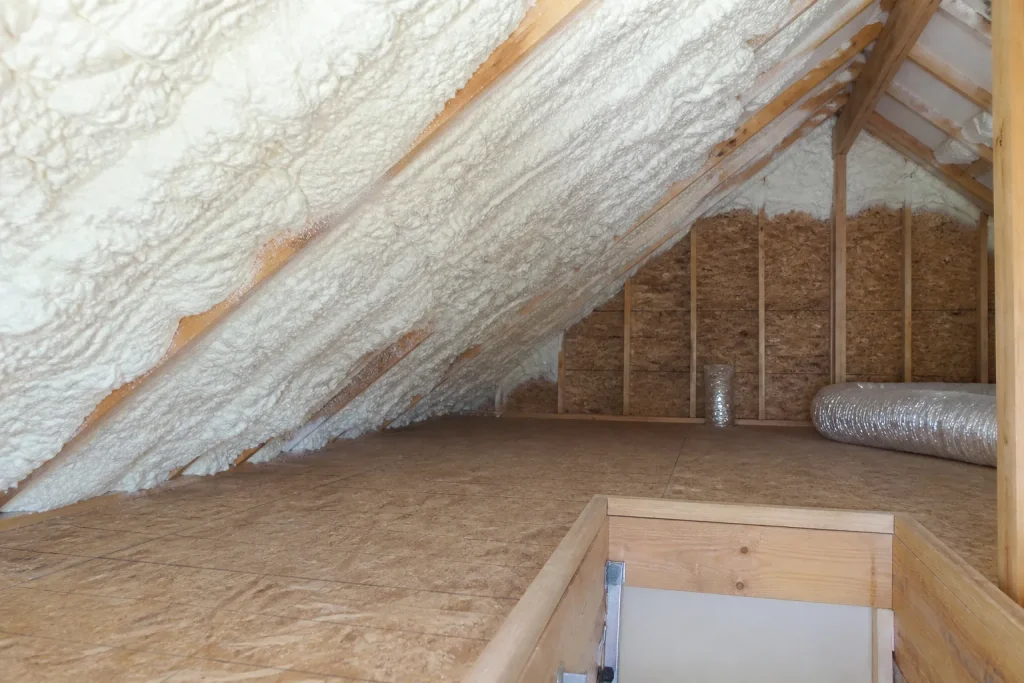
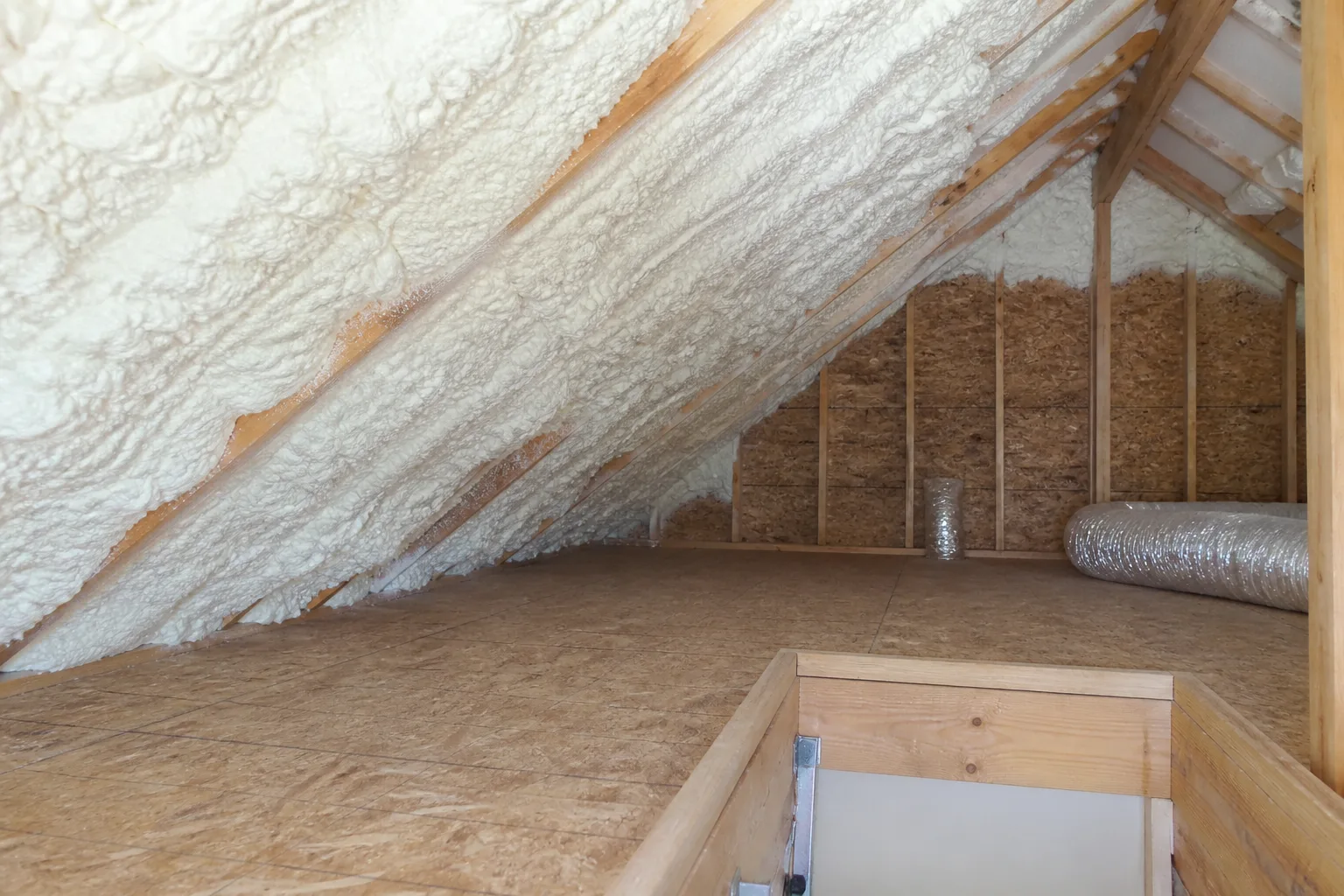
There is one application where open-cell Icynene is unambiguously correct, and it’s the one most homeowners don’t hear about. That’s the unvented, conditioned attic assembly – insulation applied to the underside of the roof deck rather than the attic floor, bringing the HVAC equipment and ductwork inside the thermal envelope.
Las Vegas summers push attic temperatures past 140°F. If your air handler and ducts sit in that space, you’re paying to cool equipment that’s cooking. Moving them inside the envelope is the fix, and open-cell foam at the roof deck is how you do it without creating a moisture trap.
Why open-cell specifically?
- It fills the rafter bays completely. No gaps at the edges, no convection loops behind the insulation.
- It seals as it installs. Every penetration, every top plate, every wire bay gets sealed by the foam itself.
- It’s vapor-permeable. This matters more than most homeowners realize.
For a vented attic floor – the standard scenario most Las Vegas homes have – the math changes. You’re paying foam prices for sealing that could come from targeted two-part foam at the penetrations and blown fill on top. In our experience, that’s a $300 to $600 sealing job plus a $1,200 to $2,000 blown insulation job doing the same work as an $4,000 foam job. Same blower-door result. Different invoice.
Open-cell versus closed-cell: what’s the vapor story in Climate Zone 3B?
Las Vegas sits in Climate Zone 3B, which is warm and dry. That classification changes which foam is correct, and it’s where a lot of national spray foam marketing gets Las Vegas wrong.
Open-cell Icynene runs about R-3.7 per inch. Closed-cell runs R-6 or better per inch. Closed-cell also behaves as a vapor barrier; open-cell does not.
In a cold climate, a vapor barrier on the inside of the assembly is often the right move. In Climate Zone 3B, vapor barriers on attic assemblies are generally the wrong instinct – they trap moisture that would otherwise dry to the outside, and in a hot-dry climate, drying potential is what protects the assembly. Open-cell’s permeability is a feature here, not a limitation.
There’s a cost side to this too. To hit Nevada’s prescriptive R-49 at the roof deck with open-cell at R-3.7 per inch, you need roughly 13 inches of foam. Closed-cell at R-6+ hits R-49 in about 8 inches. Closed-cell is denser material at a higher per-board-foot price, so the 13-inch open-cell job and the 8-inch closed-cell job often come out to similar total dollars – but the open-cell job does it with an assembly that can dry. That’s the trade.
We’ve seen Las Vegas contractors quote closed-cell in conditioned attics without discussing the vapor profile at all. It’s worth asking the question.
What about off-gassing and how soon can we move back in?
Icynene’s water-blown formula has a lower VOC profile than older solvent-blown foams, and most homeowners notice a mild odor that dissipates within 24 to 48 hours. Full cure – the point where the foam has finished reacting and reached its final physical properties – is faster in a hot attic than in a cool basement, but the attic environment is exactly why re-occupancy timing needs a real answer from the installer, not a vague one.
What to ask before the crew arrives:
- What’s the re-occupancy window for this product at this thickness? Get hours, not “a day or so.”
- What ventilation is being run during installation? Attic fans, open soffits, or nothing?
- Who’s performing the cure check, and how is it documented?
In a Las Vegas July, attic temperatures actually accelerate the cure chemistry. In a December install, it’s slower. The install window matters, and the written scope should name it.
What should the blower-door reading and documentation actually show?
A blower-door test – a pressurization reading that shows, in a single figure, how much air your building envelope is losing – is the only honest way to know whether the foam did what you paid for. On an Icynene conditioned attic, the blower-door result should show a meaningful reduction in CFM50 – often 30% to 50% – because the assembly is now a sealed envelope rather than a vented one. On a vented attic floor application, the same foam delivers a smaller delta, because the attic is still vented and the sealing is only as good as the penetrations the foam reached.
That’s why the reading matters more than the sales sheet. A vented-attic foam job that drops CFM50 by 15% and a conditioned-attic job that drops it by 45% are both “Icynene jobs,” but only one bought the homeowner the performance they thought they were getting.
The written documentation should include:
- The application type (vented attic floor vs. unvented roof deck) – in plain language.
- Installed thickness measured at multiple points, not a single number, and not “approximately.”
- The before-and-after blower-door readings in CFM50, and ideally ACH50 (air changes per hour at 50 pascals) so you can compare to code.
- The ACH50 result against the code target for your assembly.
- Photos of the sealed penetrations and the applied thickness at each measurement point.
If a contractor can’t produce that list on paper before work starts, that’s not a documentation gap – it’s a documentation plan. You’ll want to know which one you’re buying.
When is it worth calling a pro instead of doing this yourself?
Spray foam is not a DIY product. The two-part chemistry reacts at temperature and pressure, the equipment is rented and calibrated, and a homeowner applying foam in a Las Vegas attic in July is asking for a bad ratio, poor adhesion, or an off-gassing problem. We’ve seen jobs where an under-applied foam created a vapor trap in the assembly and the homeowner was back to square one after a year. This is the kind of product where the installation is the product.
The other reason to call: air sealing has to happen first, in the right order. Blowing insulation – foam or fiber – over an unsealed attic floor is the most common failure we see. Top plates, can lights, and penetrations need two-part foam before anything else goes down. Sealed first, then insulated, always.
If you’re considering foam and want a second read on the quote you have in hand, we’ll read it with you – that’s a free second opinion on any written estimate, and there’s no obligation attached.
Related services in Las Vegas: Attic Insulation in Las Vegas, Spray Foam Insulation in Las Vegas, and Crawl Space Encapsulation & Vapor Barrier in Las Vegas. If you’re starting at the envelope, the Envelope Insulation Las Vegas home page has the full service line.
The Bottom Line
Icynene open-cell in a Las Vegas attic is a specific tool for a specific job. If you have a vented attic floor and a standard gas furnace in the garage, blown insulation plus targeted air sealing at the penetrations will get you the same blower-door result for roughly a third of the money. If you have – or want – a conditioned attic assembly with the HVAC equipment inside the thermal envelope, open-cell Icynene at the roof deck is the right product, and its vapor permeability is what makes it correct for Climate Zone 3B.
Either way, the question to hold any contractor to is the same: what will the before-and-after blower-door reading show, and will it be in writing before anyone lifts a tool? That’s Haven Standard Clause 1 – written price, written scope, written warranty before work starts – and it’s how we’ve documented every job since 2016. Our technicians have up to 10 years of experience, and every visit comes with a Documented Photo Record.
If you’re in Las Vegas and want a straight read on whether Icynene is the right call for your attic, Envelope Insulation Las Vegas offers free estimates – call (833) 362-4859.
Frequently Asked Questions
It depends entirely on the assembly. In a vented attic floor application, no – blown insulation plus targeted air sealing gets you the same result for a third of the price. In a conditioned attic where the roof deck is insulated and HVAC equipment sits inside the envelope, yes – open-cell Icynene is the correct product and its vapor permeability is an advantage in our climate zone. Call (833) 362-4859 to talk through which one your attic is.
No. Open-cell Icynene is vapor-permeable, which is generally the right behavior for a Climate Zone 3B assembly. Closed-cell foam behaves as a vapor barrier, and in a hot-dry climate that can be the wrong tool because it reduces drying potential. In a conditioned attic here, open-cell’s permeability is usually a feature, not a limitation.
Most homeowners can return within 24 to 48 hours after the install, though the exact window depends on thickness, temperature, and ventilation during the job. In a hot Las Vegas attic, cure chemistry runs faster than in cooler climates, but the installer should still give you a specific number in hours, not a vague “a day or so,” and put it in the written scope.
Not without removing or assessing the existing material first, and not before air sealing is complete at penetrations. Foam over an unsealed attic floor seals in leaks without fixing them, and foam over contaminated or rodent-soiled insulation creates a problem you’ll have to unwind later. The order is: assess, seal, then insulate. Call (833) 362-4859 for a free written estimate that names the sequence.
Written by the team at Envelope Insulation Las Vegas.
Need Insulation Help?
Call Envelope Insulation Las Vegas - licensed & insured, here with fast after-hours help in Las Vegas.
(833) 362-4859