Demilec Attic Insulation in Las Vegas: A Homeowner’s Guide
A Demilec open-cell job sprayed at 11 a.m. in July on a Las Vegas roof deck can fail adhesion testing by 3 p.m. the same day. Not because the foam is flawed, but because the deck surface ran 40°F past the application temperature window before lunch. In our experience, substrate conditions during the pour decide long-term performance far more than the R-value printed on the data sheet. This guide covers what the temperature log and the post-cure blower-door number tell you that the product literature never will.
If you’d rather not sort through spray foam specs on your own, call (833) 362-4859 and we’ll walk you through what your attic actually needs.
Does Demilec foam actually work in a Las Vegas attic?
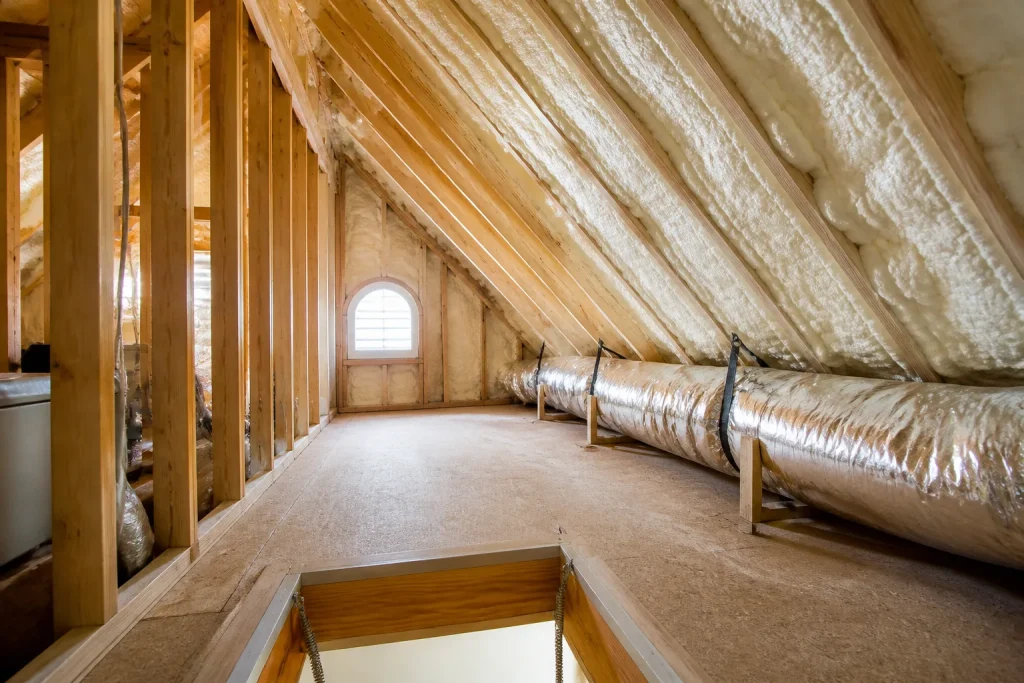
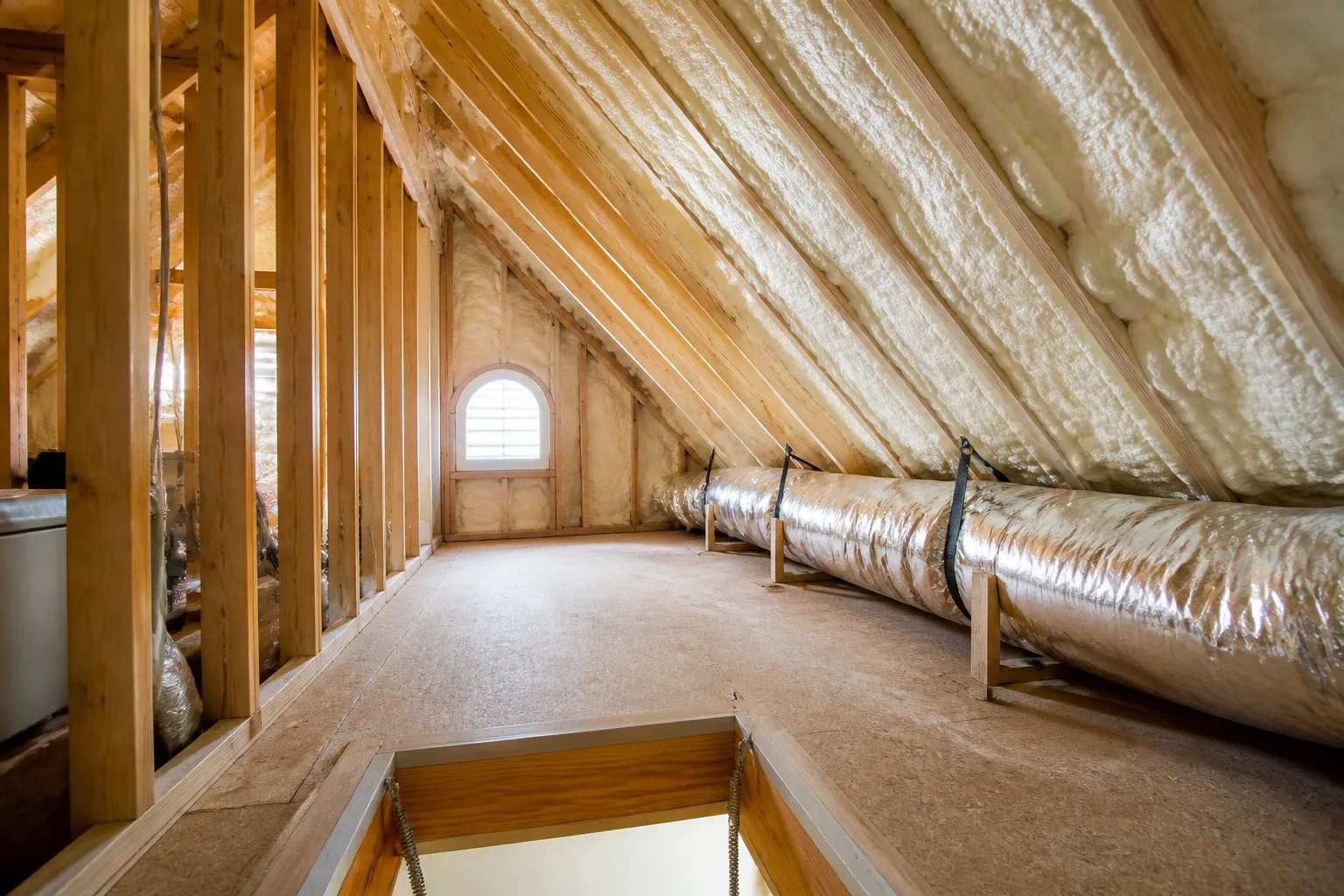
Yes, when it’s installed inside the manufacturer’s substrate temperature window and over a properly sealed attic floor. Demilec (now part of Huntsman’s building solutions line) makes both open-cell and closed-cell spray polyurethane foam, and both perform well in Las Vegas when the installer respects the conditions. The failure mode we see most isn’t the product. It’s a crew spraying onto a deck that’s too hot, too cold, or too dirty, then leaving without documenting any of it.
Las Vegas attics run hot. Attic deck temperatures here regularly hit 160°F in July and August, and the diurnal swing between a 3 a.m. low and a 3 p.m. peak is commonly 45°F. That swing matters because foam cures by an exothermic reaction, and the substrate temperature at the moment of application changes adhesion, cell structure, and cure time. A deck at 155°F is outside the window most Demilec open-cell specs allow. A deck at 60°F in January is outside it on the cold end. The installer has to log the surface temperature and work within it, or the job is guesswork.
What that looks like in practice:
- Closed-cell Demilec is the better fit for Las Vegas roof decks and the underside of sheathing in unvented assemblies, because its higher density and lower vapor permeability handle the extreme attic heat and the monsoon-season humidity spikes better than open-cell.
- Open-cell Demilec works well on interior walls, rim joists, and attic floor applications where you want a lower-density, vapor-open product and the substrate can be brought into the temperature window before spraying.
- Substrate temperature logging during the pour is what separates a documented job from a hopeful one. Ask for it in writing.
If you’re weighing spray foam against a blown-in approach, our Spray Foam Insulation in Las Vegas page lays out how the two compare for local homes.
Closed-cell vs. open-cell Demilec: how do you choose for Las Vegas?
Closed-cell for the roof deck and any assembly where you need a vapor retarder and structural rigidity; open-cell for interior walls, rim joists, and attic floors where vapor openness and cost matter more than density. That’s the short answer for Las Vegas specifically, and here’s why the decision isn’t the same here as it is in a milder climate.
The 45°F diurnal temperature swing you get in a Las Vegas summer puts real stress on any building assembly. Closed-cell Demilec’s higher density (typically 1.7 to 2.0 lb/ft³) gives the sheathing more support against thermal movement, and its low vapor permeability helps manage the moisture that comes in during the July-to-September monsoon window. Open-cell runs closer to 0.5 lb/ft³ and stays vapor-open, which is a good fit for interior walls where you want the assembly to dry inward.
A few selection criteria we use in the field:
- Roof deck application: closed-cell Demilec, sprayed after the deck is brought into the temperature window and the seams and penetrations are sealed.
- Attic floor over an existing ceiling: if you’re converting to an unvented assembly, closed-cell on the roofline; if you’re keeping the attic vented, open-cell or a blown-in product over a sealed floor.
- Rim joists and band areas: either works; closed-cell wins on air sealing in our experience, but open-cell is often the right budget call.
- Monsoon-season timing: Las Vegas gets most of its rain between July and September, and spraying during a high-humidity stretch can extend cure time. That’s a scheduling question, not a product one.
For a fuller comparison across product families, including how Rockwool and CertainTeed mineral wool options fit into a mixed assembly, see our Attic Insulation in Las Vegas page.
What should the substrate temperature log show, and why ask for it?
It should show the surface temperature of the substrate at the start, middle, and end of the spray, taken with a calibrated infrared thermometer, along with ambient temperature and relative humidity. If the log doesn’t exist, the documentation is incomplete. That’s the position we take, and it comes from a plain fact: foam adhesion is a substrate-condition story, and you can’t test for it after the fact without tearing out what you paid for.
Manufacturers publish temperature and humidity windows for a reason. Demilec’s spec sheets give substrate and ambient ranges that keep the material inside its cure envelope. A crew that sprays a hot Las Vegas deck at 160°F without checking is betting your attic on luck. A crew that logs the temperatures is showing you it worked inside the envelope.
The documentation a homeowner should walk away with after a Demilec attic job:
- Substrate temperature log with time-stamped readings across the spray window.
- Thickness measurements at multiple points, taken wet or post-cure per the manufacturer’s method.
- Material lot numbers from the drums, so the batch is traceable.
- Adhesion check results, if the installer ran them, with the site conditions at the time.
- Post-cure blower-door readings before and after, so you can see the air-tightness change in a single number.
What should the post-install blower-door number show?
A Demilec unvented attic conversion in a typical Las Vegas home should bring the blower-door result (CFM50, the airflow at 50 pascals of pressure) down substantially from the pre-work baseline. We’ve seen conversions drop from the 4,000s into the 2,000s on a mid-century ranch house in the central valley, and the number is what tells you whether the assembly actually sealed. A traditional vented attic with a properly air-sealed floor and blown-in insulation will land lower than the starting point too, but usually not as low as an unvented conversion, because the ductwork and air handler move inside the envelope.
That’s why we publish before-and-after blower-door numbers on every job where the test applies. It’s the one figure that shows what you paid for in measurable terms, and it’s also the number a future buyer or appraiser can use to understand the home’s performance.
The blower-door test – a pressurization reading that shows, in one number, how much air your building envelope is losing – is also where we catch problems the foam won’t fix. If the pre-work test shows air pouring in past top plates, can lights, and plumbing penetrations, the answer isn’t more foam. It’s sealing those leaks first. Under Haven Standard, we seal first, then insulate, in that order, and we won’t blow foam or any other product over an unsealed attic floor. It’s not an upsell. It’s the whole job.
HFO blowing agents and Nevada energy code: what the disclosure says
Demilec’s HFO-blown closed-cell products use hydrofluoroolefin blowing agents, which carry a much lower global warming potential (GWP) than the older HFC-blown foams. That matters for a Las Vegas homeowner for two reasons: code commentary in Nevada has been moving toward GWP disclosure on foam products, and some buyers, appraisers, and lenders want to see the number. Ask for the manufacturer’s GWP documentation with the job paperwork. It’s a one-page sheet, and a crew that can produce it is telling you something.
We source from Demilec, Icynene, Owens Corning, Johns Manville, Knauf, Rockwool, CertainTeed, and GreenFiber precisely because we don’t want a homeowner locked into one proprietary product line. If an HFO-blown closed-cell foam doesn’t fit your project, there’s an alternative. No proprietary lock-in means the recommendation follows the house, not a distributor agreement.
If your assembly includes a crawl space (and many Las Vegas homes do), the vapor barrier side of the envelope matters as much as the attic side. Our Crawl Space Encapsulation & Vapor Barrier in Las Vegas page covers that half of the picture.
Red flags in a Demilec bid that skips air sealing
A bid that quotes Demilec foam without a line item for air sealing the attic floor bypasses is the biggest warning sign we see in Las Vegas. Foam sprayed over an unsealed top plate, recessed light, or plumbing chase traps the leak inside the assembly. The attic gets tighter. The living space stays leaky. And the blower-door number barely moves.
Other red flags worth catching before you sign:
- No written price before work starts. Under Haven Standard Clause 1, the flat price, written scope, and written warranty are in your hands before anyone lifts a tool.
- No mention of substrate temperature. If the bid never references conditions, the installer is planning to spray regardless of deck temperature.
- No post-install blower-door test offered. Without a before-and-after reading, there’s nothing to verify.
- No documentation of what was done. Every job we finish includes a Documented Photo Record. It’s included, not available on request.
- No written warranty. The 365-Day Done Right Promise is only meaningful because it’s in writing.
If a competitor’s bid leaves these out, bring it to us. We offer a free second opinion on any written estimate. We’ll read it with you. If their bid is good, we’ll say so.
When to call a pro
Spray polyurethane foam involves isocyanates, exothermic reaction heat, and pressurization equipment. This isn’t a homeowner job, and we don’t recommend trying to replicate a Demilec pour with a kit from a big-box store. The safety and quality questions are real, and the documentation is what protects your investment. Call a trained, insured contractor. Our technicians have up to 10 years of experience, we’re licensed and insured, and a live person answers the phone 24/7.
Related services in Las Vegas: Envelope Insulation Las Vegas home.
The Bottom Line
Demilec foam is a strong choice for a Las Vegas attic when three things happen in order: the attic floor gets sealed first, the substrate temperature gets logged during the spray, and a post-cure blower-door reading documents the result. If a bid is missing any of those, it’s not a bid for a finished job. In our experience, the homes that perform best after a year of 160°F July afternoons are the ones with paperwork that shows what the crew found and what they did about it.
If you’re in Las Vegas and need help, Envelope Insulation Las Vegas offers free estimates. Call (833) 362-4859 for a written price before any work starts.
Frequently Asked Questions
Yes, once cured. Demilec spray foam is applied by trained technicians wearing full PPE, and the material cures within hours depending on conditions. The isocyanates in the uncured product are the concern, which is why we don’t recommend DIY kits. Ask for the material data sheet and the cure documentation with your job paperwork.
Most open-cell attic floor jobs in a Las Vegas home run roughly $2.50 to $4.50 per square foot of coverage, and closed-cell roof deck applications run higher, often $5.50 to $8.50 per square foot, because of the greater thickness and density. Air sealing and the blower-door testing add to that. Call (833) 362-4859 for a written price before any work starts, and estimates are free.
Often yes, depending on scheduling and cure conditions. Las Vegas summer heat can actually slow the schedule because decks have to cool into the application window before the spray starts, and monsoon-season humidity can push a cure time longer. Call (833) 362-4859 and we’ll tell you what the calendar actually looks like.
Sometimes, yes. A vented attic with a well-sealed floor and blown-in fiberglass or cellulose will outperform an unvented Demilec conversion that skipped the air sealing, and it usually costs less. But if your ducts and air handler are in the attic, moving them inside the envelope with an unvented Demilec assembly often pays back faster over the long run. The blower-door baseline is what tells you which way to go. Call (833) 362-4859 for a free estimate.
Written by the team at Envelope Insulation Las Vegas.
Need Insulation Help?
Call Envelope Insulation Las Vegas - licensed & insured, here with fast after-hours help in Las Vegas.
(833) 362-4859