
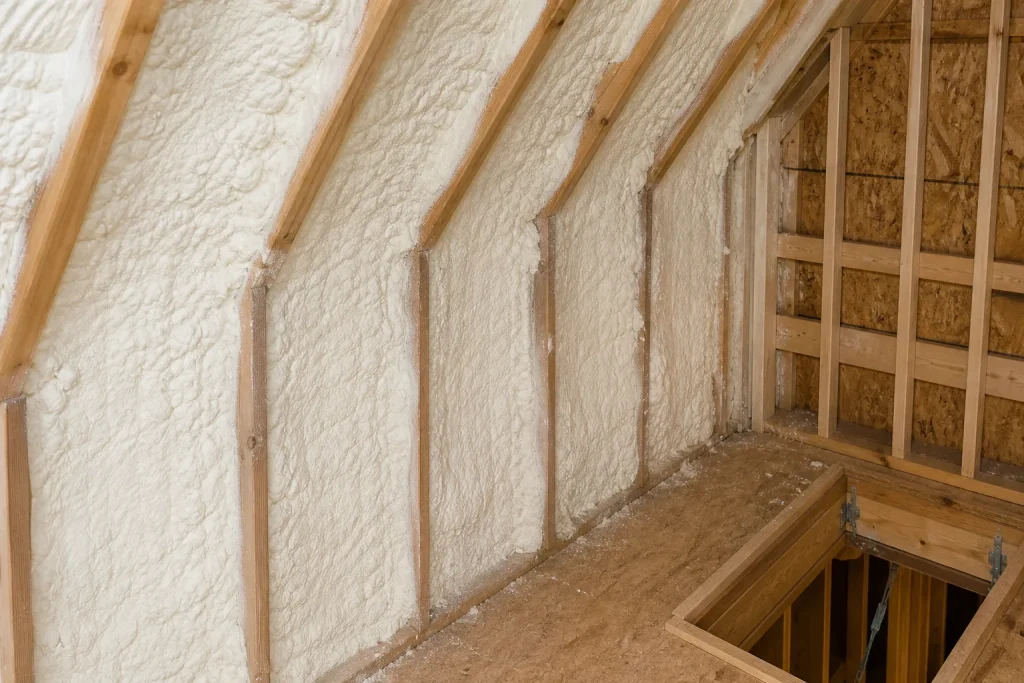
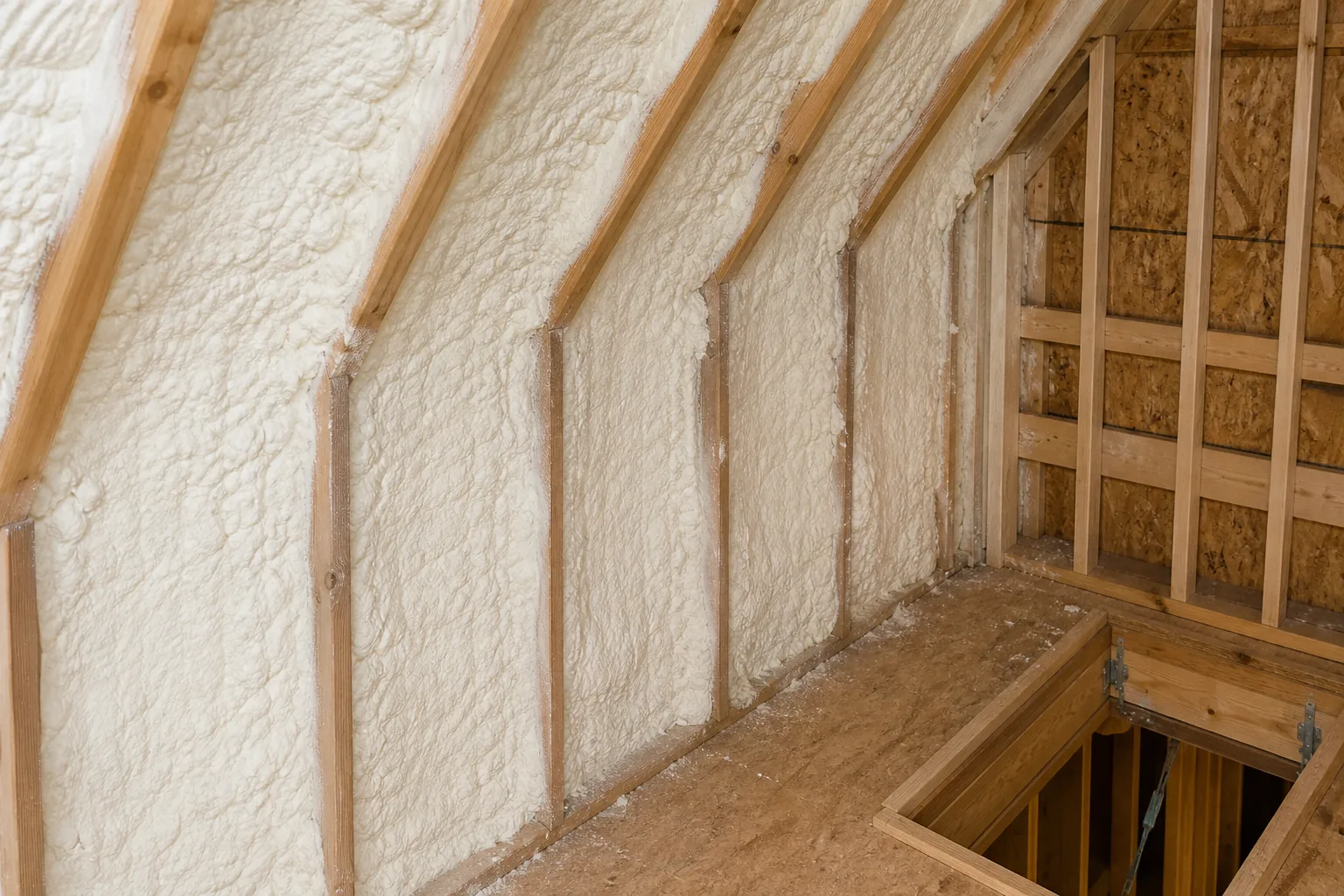
5 Mistakes to Avoid With Spray Foam Insulation
The five most expensive spray foam mistakes in Las Vegas aren’t application errors. They’re pre-installation and post-installation failures that the foam itself hides permanently once it cures. Spray foam applied over an active roof leak in a Las Vegas attic will cure perfectly, hold its R-value, and trap moisture against the sheathing for years without a single visible sign, until the OSB delaminates and the repair cost exceeds the original foam job. Every one of these mistakes is preventable with a written pre-work checklist and a blower-door test after the job closes. If you’d rather not gamble on it, call (833) 362-4859 and we’ll walk through your attic with you.
How can you tell if your attic is too wet for spray foam?
You can’t tell by looking, and that’s the problem. Foam applied over wood above 19% moisture content seals that moisture in. Wood that wet is already on its way to rot or mold, and once a closed-cell layer cures over it, there’s no drying path left. The failure shows up two to five years later as soft sheathing, a musty smell in the upstairs hallway, or a stain on the ceiling that appears to come from nowhere.
Before any foam goes in, the substrate gets a pin-type moisture meter reading at multiple points: roof sheathing, top plates, and any wood that showed staining. Readings come in a written report. If any spot reads above 19%, the job stops until the source is found and the wood dries below threshold. In our experience, Las Vegas attics hit that number more often than homeowners expect, usually after a monsoon-season roof leak or a swamp cooler line that’s been dripping behind the framing for a season. A roof leak that small never shows on the ceiling because the foam (or the old insulation) soaks it up first.
What documentation proves it was checked? A moisture reading log with locations and percentages, dated before application. If a contractor can’t produce one, the reading either didn’t happen or wasn’t recorded, and you have no way to know which.
Why isn’t visual inspection of foam coverage good enough?
Because foam can look complete and still leave gaps. Visual inspection confirms the foam is there. It doesn’t confirm the air barrier is continuous. Those are two different things, and only one of them shows up on your energy bill.
A blower-door test – a pressurization reading that shows, in one number, how much air your building envelope is losing – is the check that matters. It’s run before the job and again after. A well-sealed Las Vegas attic typically drops from somewhere in the 3,500 to 5,000 CFM50 range down to half that or better. If the after-number barely moves, the foam has a gap somewhere, and it’s usually at a penetration the crew missed: a can light, a plumbing chase, the top plate behind a knee wall.
We publish before-and-after blower-door numbers on every applicable job for exactly this reason. It’s the only way a homeowner can see the performance change they actually paid for, in a figure rather than a promise. Ask any contractor for the after-test before final payment. A crew that did the work right has no reason to hesitate.
Can you use open-cell foam in an unvented Las Vegas roof assembly?
You can, but not by itself. Open-cell foam in an unvented roof assembly needs a code-compliant vapor retarder installed on the warm side (against the conditioned space) or a vapor-retarder coating on the foam’s exposed face. Skip that and you’ve created a dew point problem inside the roof deck.
Here’s the calculation in plain terms. Las Vegas summers put the attic side of the roof sheathing well above 130°F, and the conditioned space below sits around 75°F. The dew point lands somewhere inside the foam layer or right at the sheathing. Open-cell foam is vapor-permeable, so moisture vapor migrates through it and condenses on the cold sheathing surface. In winter the gradient reverses and the same spot stays wet. Over several seasons, that’s a wet roof deck with no way to dry.
Closed-cell foam at two inches or more acts as its own vapor retarder in most assemblies and needs no additional layer. Open-cell needs the retarder specified, priced, and installed. The written scope should say which product is going in and why, and the dew-point logic should be on the page. If your estimate just says “spray foam – attic,” ask what the vapor retarder plan is. When we run a spray foam job, we use Icynene or Demilec depending on the assembly, and the choice is spelled out in the scope before anyone lifts a tool.
How fast does sunlight break down open-cell foam in a Las Vegas attic?
Faster than most people think. Cured open-cell foam exposed to direct UV in a vented Las Vegas attic starts to chalk and powder at the surface within 12 to 24 months. Within three to five years the surface layer gets brittle, dusts off on contact, and loses its air-sealing function at the face even though the R-value deeper in the foam holds. Las Vegas gets roughly 290 sunny days a year and summer attic temperatures that push past 150°F, so the degradation clock runs faster here than in most of the country.
Which attics are at risk? Any with ridge vents, gable vents, or soffit vents that let daylight reach the foam. The fix is simple: an approved ignition barrier or intumescent coating over the exposed foam face, applied per the manufacturer’s spec. It blocks UV, satisfies code, and costs a fraction of re-foaming.
We pulled a job out of a garage in Summerlin last spring where the homeowner had open-cell foam sprayed three years earlier with nothing over it. The surface had gone chalky and was shedding a fine dust onto everything stored below. The foam underneath was fine. The exposed face was finished. A coating would have prevented it.
Why does the written contract need to name what the foam is for?
Because “spray foam insulation” describes a material, not a job. The contract has to specify whether the foam is going in as a thermal barrier (R-value), an air barrier (sealing), or both. That distinction decides whether the install meets code and, if it doesn’t, who pays to fix it.
Air barrier and thermal barrier have different installation requirements, different testing standards, and different failure modes. A crew told to hit an air-barrier spec focuses on continuity at penetrations and seams. A crew told to hit a thermal spec focuses on thickness and R-value per inch. Neither job is wrong. They’re just different jobs, and a vague scope leaves room for both sides to be right while your attic underperforms.
What belongs in writing before work starts:
- Intended function: thermal barrier, air barrier, or both – named explicitly.
- Product and thickness: closed-cell or open-cell, brand, and installed depth per area.
- R-value target: the number the job will be measured against.
- Vapor retarder plan: required or not, and if required, what’s going in and where.
- Testing: pre- and post-install blower-door readings, and who pays if the target is missed.
- Warranty: the written warranty, delivered before anyone starts.
Under Haven Standard Clause 1, a flat price, written scope, and written warranty land before any work begins, no exceptions. If an estimate doesn’t spell out the intended function, you’re not looking at a scope. You’re looking at a guess.
When to call a pro
Spray foam involves isocyanates and exothermic cure, and a two-part proportioner that has to be dialed in correctly or the foam never cures right. This isn’t a weekend project. If you’re dealing with a wet attic, an unvented roof assembly, or a job that needs a blower-door test to prove it worked, call a trained professional. Our technicians have up to 10 years of experience, and a live person answers the phone around the clock.
Related services in Las Vegas: Spray Foam Insulation in Las Vegas handles the application side, and Attic Insulation in Las Vegas covers the sealing-first approach that makes foam perform the way it’s supposed to. If the moisture problem traces back to the foundation, see our Crawl Space Encapsulation & Vapor Barrier in Las Vegas page.
The Bottom Line
Every mistake on this list hides behind the foam once it cures. A moisture reading above 19% that nobody took, a blower-door test nobody ran, an open-cell roof assembly with no vapor retarder, unexploded UV on an exposed foam face, and a contract that never named the intended function – each one looks like a finished job on the day the crew leaves. The damage shows up years later, and the repair usually costs more than the original install. The prevention is boring and cheap: a written checklist before work starts, and a documented after-test when it closes.
If you’re in Las Vegas and need help, Envelope Insulation Las Vegas offers free estimates. We’ll read your existing estimate with you, no pressure, and a written price lands before any work starts. Call (833) 362-4859. You can also start at our Envelope Insulation Las Vegas home page.
Frequently Asked Questions
Installing over wet substrate. Wood above 19% moisture content traps that moisture permanently once foam cures, and the damage shows up years later as delaminated sheathing. A moisture reading log, taken before application and kept on file, is the proof it was checked. Call (833) 362-4859 for a free estimate and we’ll walk through what the reading should cover.
Yes. Visual inspection confirms foam is present, not that the air barrier is continuous. A blower-door test after installation confirms the seal actually holds, and a well-sealed Las Vegas attic typically cuts its CFM50 reading in half or better. Ask for the after-number before final payment. Call (833) 362-4859 to schedule one.
Only when it’s installed wrong. Closed-cell foam acts as its own vapor retarder. Open-cell foam in an unvented roof assembly needs a code-compliant vapor retarder or coating, or moisture condenses inside the roof assembly. The written scope should name which product is going in and why. Call (833) 362-4859 for an estimate that spells it out.
Most attic spray foam jobs in Las Vegas run between $2,500 and $7,500 depending on square footage, whether you choose open-cell or closed-cell, and whether an ignition barrier coating is needed. The written price should name product, thickness, and R-value before work starts. Call (833) 362-4859 for an exact quote. Estimates are free.
Written by the team at Envelope Insulation Las Vegas.
Need Insulation Help?
Call Envelope Insulation Las Vegas - licensed & insured, here with fast after-hours help in Las Vegas.
(833) 362-4859