GreenFiber Attic Insulation in Las Vegas: A Homeowner’s Guide
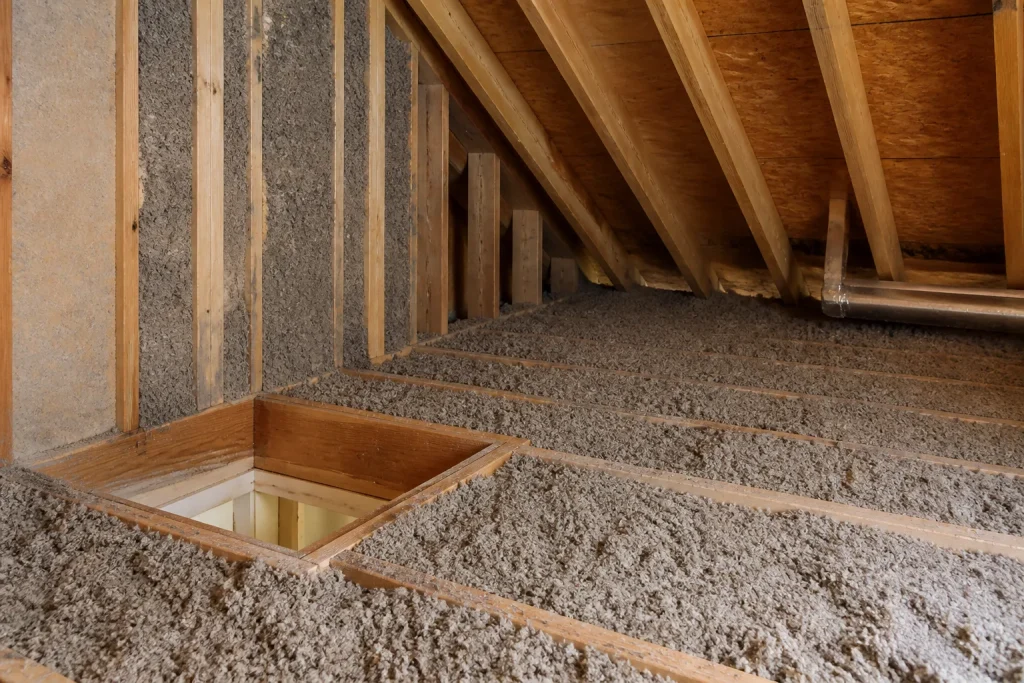
GreenFiber cellulose settles roughly 20% in its first year. An installer who blows to 16 inches of initial depth in a Las Vegas attic is delivering about 12.8 inches of effective depth by summer two, and most job receipts document the former, not the latter. The number stapled to your attic hatch records what went in, not what stayed. That gap is the whole story of whether cellulose actually performs in a Las Vegas attic, and it’s the part almost nobody measures. If you’d rather have someone who documents the settled number than the installed one, call (833) 362-4859.
What is the difference between installed depth and settled depth?
Installed depth is what the installer reads off a ruler the day the blower stops. Settled depth is what you actually live with once the material has compacted under its own weight and the attic’s daily temperature swings. GreenFiber and other loose-fill cellulose products are manufactured to settle, and the bag label carries a settled-density figure the installer is supposed to hit. The problem is that “supposed to” is doing a lot of work in that sentence.
Cellulose is chopped newsprint treated with borate. It goes in fluffy at roughly 1.5 to 2.0 pounds per cubic foot of installed density depending on the target R-value, and it compacts toward its rated settled density over the first heating and cooling cycles. In a Las Vegas attic, those cycles arrive fast. Attic deck temperatures here routinely climb past 140°F in July, and the expansion and contraction that comes with a 100°F daily swing pushes compaction harder than a mild climate would. Las Vegas’s low humidity is the other half of it: humid climates let cellulose hold a little moisture and stay lofted longer, while our dry air lets it pack down to its stable density quicker.
What that means in practice:
- A 16-inch install at R-49 target settles to roughly 12.8 to 13.5 inches of effective depth within 12 months.
- The R-value per inch of settled cellulose runs about 3.2 to 3.8 depending on density, so losing 3 inches costs you roughly R-10 to R-12 of the R-value you paid for.
- An installer who documents only initial depth hands you a receipt for the wrong number.
If you’re comparing blown-in options, our Attic Insulation in Las Vegas page covers how we spec settled density into the written scope before anything is blown.
How does Las Vegas’s climate affect GreenFiber’s settling rate?
Las Vegas attics are a hostile environment for any loose-fill product, and cellulose gets hit on two fronts at once. The first is thermal cycling. Between a winter morning at 45°F and a July afternoon at 150°F on the attic deck, the material expands and contracts against itself dozens of times a year, and every cycle nudges it toward its settled density. In a humid climate, cellulose stays slightly lofted because ambient moisture keeps the fibers from packing tight. Here, the single-digit relative humidity most of the year dries the fibers out and lets them collapse into a tighter matrix.
The second front is alkaline dust. Las Vegas sits on a lot of calcium carbonate and gypsum-rich soil, and attic dust in this valley runs alkaline. Borate-treated cellulose (which is what GreenFiber is) is naturally pH-buffered, so it holds up reasonably well, but a thick layer of alkaline dust settling on top of the blown material can, over several years, slightly reduce the fire-retardant surface area available on the individual fibers. It’s not a fire hazard in a properly installed attic, but it’s one more reason the depth reading should be taken with a clean ruler at multiple points rather than eyeballed from the hatch.
We’ve pulled insulation out of attics in Summerlin and in the older tracts off Sahara where the material had settled to under 8 inches of effective depth after five years. The homeowners had receipts showing 14 inches installed. Nobody had ever re-measured.
Why must air sealing come before GreenFiber goes in?
This is the single most important thing to understand about cellulose in a Las Vegas attic. If you blow cellulose over an unsealed attic floor, every gap in the ceiling plane becomes a channel for what the trade calls wind-washing: conditioned air escaping from the house pushes up through the insulation at each bypass, fluffs the cellulose aside, and creates a low-density channel that insulates almost nothing. Over a couple of seasons, those channels widen into visible divots in the coverage.
The bypasses that matter most in a Las Vegas home built between 2015 and 2023:
- Recessed can lights, especially the older non-IC-rated fixtures that leak air straight out of the conditioned space.
- Plumbing chases running from the attic down through interior walls, which are usually open at the top plate.
- Top plates where the wall framing meets the ceiling drywall, which are rarely sealed in production builds.
- Chimney and flue penetrations, bathroom fan housings, and the gaps around HVAC boots at the supply registers.
Sealing first also protects the R-value you paid for. On jobs where we’ve measured, sealing the top plates and can lights before blowing cellulose is worth 1,500 to 2,500 CFM50 of leakage reduction, which is often more energy savings than the insulation thickness itself. That’s why we don’t blow cellulose over an unsealed floor, full stop. If you want to see what that kind of leak reduction looks like in your own home, our Envelope Insulation Las Vegas home page walks through how a blower-door test measures it.
What R-value does GreenFiber deliver against Las Vegas’s climate zone requirements?
Las Vegas sits in IECC climate zone 2B, and Nevada’s Title 24 energy code aligns with IECC for residential attic assemblies. The code minimum for an attic in climate zone 2B is R-30, but that’s a floor, not a target. Most energy programs and modern high-performance builds in this valley target R-38 to R-49 in the attic because the cooling-dominated climate means the attic is a major heat source from May through October.
GreenFiber’s published coverage chart gives you a bag count per target R-value. A typical 1,500-square-foot Las Vegas attic at R-49 needs roughly 40 to 45 bags of GreenFiber at the manufacturer’s specified settled density, or about 27 to 30 bags at R-38. The bag count is the number that matters, not the inflated depth on the ruler.
| Target R-value | Approximate bags per 1,000 sq ft | Settled depth (inches) | Typical installed cost in Las Vegas |
|---|---|---|---|
| R-30 (code minimum) | 18 – 20 | 8 – 9 | $1,100 – $1,500 |
| R-38 (common upgrade) | 22 – 25 | 10 – 11 | $1,300 – $1,800 |
| R-49 (high-performance) | 28 – 32 | 13 – 14 | $1,600 – $2,200 |
| R-60 (deep retrofit) | 34 – 38 | 16 – 17 | $1,900 – $2,600 |
Those ranges are for a typical 1,500-square-foot single-story Las Vegas attic on a clean, already-sealed floor. Homes with deep attic spaces, multiple gables, or full removal of old insulation run higher. We put the flat number in writing before any work starts, so you’re not guessing from a range. If you want to see how GreenFiber compares to foam-in-place options, our Spray Foam Insulation in Las Vegas page contrasts the two on an attic floor.
How many depth measurements make a valid post-installation record in Las Vegas?
A depth-ruler photograph log needs a minimum of one measurement point per 200 square feet of attic floor for a defensible record. On a typical 1,500-square-foot Las Vegas home, that’s eight measurement points, each photographed with the ruler standing in the material and the reading visible. That’s the floor. Most competent installers take 12 to 16 on a home this size, spread corner to corner, over the center, and near the major bypass points so the record actually shows coverage.
What a proper log contains:
- One photo per measurement point, ruler touching the ceiling drywall and the reading legible.
- A handwritten note of the location (for example, “northwest corner, near HVAC plenum”).
- A settled-depth confirmation scheduled 30 to 60 days after install, once the material has begun compacting.
- A before-and-after blower-door reading, so you can see the air-sealing result in a single number.
Most job records we read from competing installers have one photo at the hatch and a written claim of the target depth. That tells you nothing about coverage in the corners, which is exactly where a cheap job shows up as a cold spot two winters later. Under our Haven Standard, a Documented Photo Record ships with every job whether you ask for it or not. If you’re comparing written estimates, we’ll read a competing quote with you for free and show you where the record-keeping falls short. If you’re also wondering about the subfloor, our Crawl Space Encapsulation & Vapor Barrier in Las Vegas page covers the related moisture question.
When should you call a pro instead of installing GreenFiber yourself?
Blowing cellulose is technically a weekend project, and a homeowner with a rental blower and a helper can do it. What homeowners can’t easily do is the air sealing and the verification. Unless you’re comfortable crawling a Las Vegas attic in July, sealing top plates and can lights with fire-rated foam and caulk, and taking a real depth log with a ruler at eight or more points, the job usually goes better with a crew that does this daily. Add in a blower-door test and the case for a pro is straightforward.
Call a pro if any of the following apply:
- You can see daylight through the top plates or around can lights from inside the attic.
- Your current insulation is under 8 inches of settled depth and you’re not sure why.
- You’ve had rodents in the attic, since contaminated insulation needs removal before new material goes in.
- Your HVAC equipment sits in the attic and needs to stay clear of the blown material.
You also want a pro if you’d like the before-and-after blower-door numbers. A DIY install has no baseline and no verification, which means you’re paying for material without knowing what it actually bought you.
Related services in Las Vegas: Attic Insulation, Spray Foam Insulation, Crawl Space Encapsulation, and a whole-home Envelope Insulation evaluation.
The Bottom Line
GreenFiber cellulose is a good product for a Las Vegas attic, but only if the installer seals the attic floor first, blows to the bag-count target rather than an inflated depth, and documents settled depth with a real photograph log. The three things to ask any contractor before they start:
- Will you air seal the bypasses before the cellulose goes in?
- What settled depth are you targeting, how many bags per square foot, and how will you verify it?
- Will I get before-and-after blower-door numbers and a photo log with the readings?
If any of those answers is vague, keep shopping. Under our Haven Standard, every job starts with a written price and a written scope, ends with a documented photo record, and carries a 365-Day Done Right Promise. If you’re in Las Vegas and want help reading a competing quote or pricing your attic, Envelope Insulation Las Vegas offers free estimates. Call (833) 362-4859.
Frequently Asked Questions
Most GreenFiber attic insulation jobs in a 1,500-square-foot Las Vegas home run between $1,100 and $2,200 depending on the target R-value, and that price includes air sealing before the cellulose goes in. A full removal and replace of contaminated insulation runs $2,500 to $4,000 because it adds disposal and rodent proofing. We put the exact flat price in writing before any work starts, so you know the number before anyone climbs into the attic. Call (833) 362-4859 for a written estimate.
It settles faster. Las Vegas’s low humidity and 100°F-plus attic temperature swings push GreenFiber toward its stable settled density in about 12 months, versus 18 to 24 months in a humid climate. That’s why we spec the settled depth into the written scope and schedule a re-measurement 30 to 60 days after install, rather than trusting the installed-depth reading alone. Call (833) 362-4859 to schedule a settled-depth check on an existing install.
No. GreenFiber is treated with borate, which gives it a Class 1 fire rating, and it doesn’t support combustion on its own. The fire concern in a Las Vegas attic is almost always the recessed can lights underneath it, not the cellulose. Non-IC-rated fixtures get dangerously hot under any insulation and need to be sealed and rated for contact or replaced before the cellulose goes down. We check every can light as part of the air-sealing step. Call (833) 362-4859 if you’re not sure what you have.
Topping off an existing cellulose layer is usually cheaper than a full replacement, at $1,100 to $1,800 for a typical Las Vegas attic, and it’s the right call if the old material is clean and hasn’t been settled below 8 inches. Replacement makes more sense if the old insulation is rodent-contaminated, matted, or missing coverage in entire sections, because topping off over a poor substrate just buries the problem. We’ll tell you which one you need in the written scope. Call (833) 362-4859 for a free second opinion on any written estimate.
Written by the team at Envelope Insulation Las Vegas.
Need Insulation Help?
Call Envelope Insulation Las Vegas - licensed & insured, here with fast after-hours help in Las Vegas.
(833) 362-4859